My Life on Two (or Three) Wheels: My Motorbikes (and sidecars)
from 1964 to the present. ... "from Beezer to CJ"
Before I get so old that I forget all about them, I want to record
my motorcycling history. From riding my first BSA in 1964 to
horsing around on a Chang Jiang just the other day, riding motorbikes
has always been a very enjoyable part of my life.
This page will probably take many weeks or months or years to
complete, and may not be done in Chronological order. So come
back again later and see whether it has grown. It is currently
in a kind of "scratch pad" state and I shall work on bits
and pieces as I have time to recall all my memories. Some of
the facts and figures may be a bit out until I can unearth some of my
old diaries from years gone by. More photos will have to wait
until I can get them from storage and scan them.
I am quite sure that several of the motorbikes listed below are
listed in the wrong order. I am pretty sure that every incident
described is listed with the correct bike, it's just that I cannot
now remember which one came first. I shall have to put them
into better order when I can get some more information.
If anyone has copies of the
Australian "Two
Wheels"
magazine dating back to the 1972-1974 period and can look up the
articles therein written by Phil Smith, please contact me at phil
DOT drdisk AT gmail DOT com
so that I can get some of these facts and figures more correct.
I particularly need a copy of the article titled "Diary of an
Enthusiast" written by me towards the end of 1972 or in the
first half of 1973. (My memory is
not as good as it was!)
A special "Thank you!" to my mother, Mrs Wenche Smith of
Geelong, who dug around amongst the family photos and found the black
and white prints and ancient polaroid photos which have been scanned
and reproduced on this page. On all photographs in this page,
click on the small Thumbnail print to get a larger photo. Some
of the colour slides which she also found are now included after
having been digitised.
Firstly, Important information for all
motorcyclists:
Presentation by CMA Qld: Where
the Rubber Hits the Road
All sections of this page below here will gradually be cut into
chapters and installed as new links here.
Note while editing: this page
and all pages from 2007-01-10 need pictures updating when internet
access gets back to normal. Meanwhile pictures will hopefully load
okay (if slowly) from old location.
1968: My First 1936 Harley-Davidson VLH 1340cc Side Valve V-twin
Both of my grandfathers had been Harley riders. While my
mother was pregnant and carrying me she rode pillion on a Harley
until she became too big to do so any more. The love of
Harleys was therefore definitely imparted to me while I was still in
the womb ... you can't get it much earlier than that! As a kid
I had loved to watch the Harleys which thundered up and down every
street on occasion. As I grew up, the Harleys always had a
special place for me. I would pull up anywhere to oggle one.
Somehow, while I was still in the Rovers, I heard about an 11-13
Harley (That meant 11 horsepower and 1300cc for those not familiar
with Harley terminology) with a box sidecar that was for sale at
£40. Its owner told me that it had been painted red when
he originally got it,but that it had all sorts of profanities and
rude words painted all over it with white house paint. He said
it had been labelled in several places with the number "666"
- the Mark of the Beast (refer to The
Bible, Revelation, Chapter 13, to find out what this referred to)
so that he had brush painted it all over with black house paint to
cover up all the bad words.
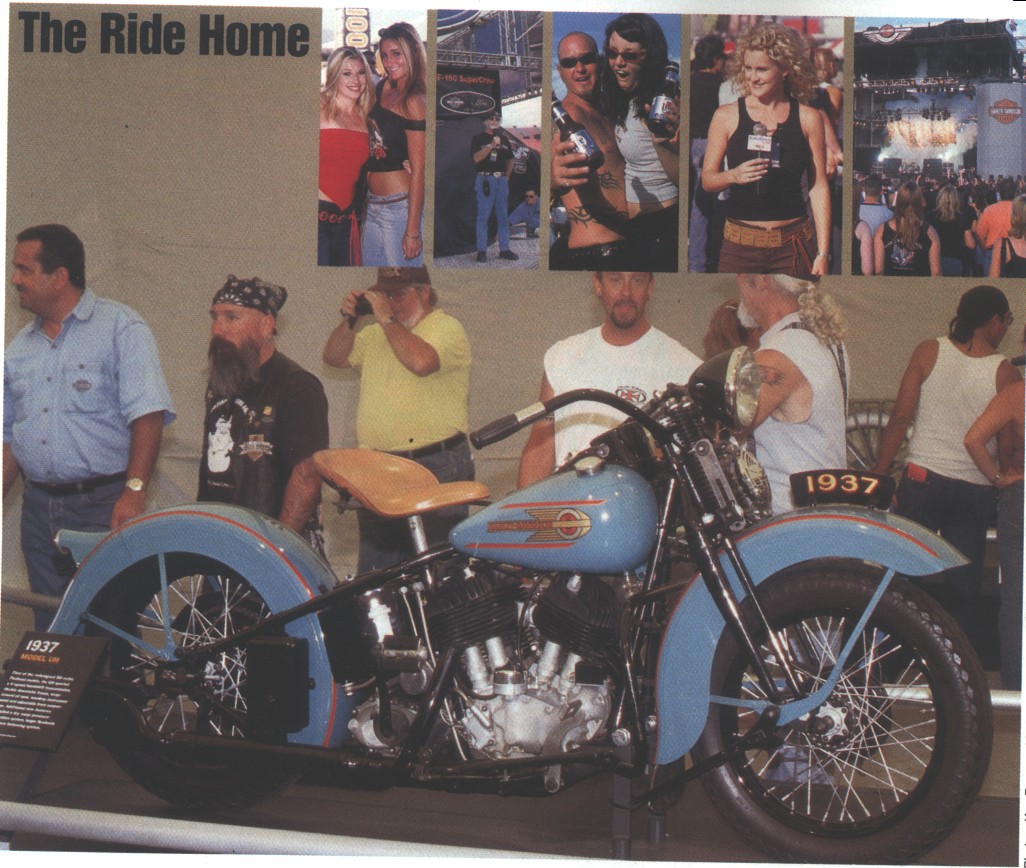
 The
picture at the right, scanned out of a magazine, shows a restored
1937 model which was almost the same as mine. The engine was a 45
degree V-twin with a capacity of 80 cubic inches or 1340cc. I
asked my friend Cec Scott to look at it and he agreed that the price
was about right. As I didn't have the forty quid, I borrowed it
from Cec, and we kept the Harley in his shed until I had saved the
money to pay him back. Then we towed the Harley out to
Buninyong where I then lived. Gradually, between gaps in a very
busy life, I worked on it little by little to bring it towards a
state where I might be able to register it for use on the road.
I mainly bought little things one at a time such as a stop light
switch and a taillight that could have a stop light fitted inside it
and so on. I would take it out for a ride on the back bush
tracks every now and then to make sure the engine stayed in good
nick, but due to money constraints and time priority constraints,
that bike never actually ended up registered during the years I owned
it. At the end of 1968, I received a posting to become the
Headmaster of the Dumbalk North Primary School located in the
Leongatha Inspectorate in South Gippsland, so when I moved to Morwell
to live with my folks, the Harley was placed on a trailer and taken
down there with me. Other Harleys joined the collection later
on; see below.
The
picture at the right, scanned out of a magazine, shows a restored
1937 model which was almost the same as mine. The engine was a 45
degree V-twin with a capacity of 80 cubic inches or 1340cc. I
asked my friend Cec Scott to look at it and he agreed that the price
was about right. As I didn't have the forty quid, I borrowed it
from Cec, and we kept the Harley in his shed until I had saved the
money to pay him back. Then we towed the Harley out to
Buninyong where I then lived. Gradually, between gaps in a very
busy life, I worked on it little by little to bring it towards a
state where I might be able to register it for use on the road.
I mainly bought little things one at a time such as a stop light
switch and a taillight that could have a stop light fitted inside it
and so on. I would take it out for a ride on the back bush
tracks every now and then to make sure the engine stayed in good
nick, but due to money constraints and time priority constraints,
that bike never actually ended up registered during the years I owned
it. At the end of 1968, I received a posting to become the
Headmaster of the Dumbalk North Primary School located in the
Leongatha Inspectorate in South Gippsland, so when I moved to Morwell
to live with my folks, the Harley was placed on a trailer and taken
down there with me. Other Harleys joined the collection later
on; see below.
1969: Triumph Trophy TR6 650cc OHV parallel twin
While the Harley was being transported to Morwell, I rode my
Yamaha YDS3 and Dusting sidecar outfit down there as well. But
it was not to stay there for long. ...
Now a Headmaster makes a
lot more money than a Student Teacher, and I felt it was about time
to upgrade my bike. I had seen films in which Triumphs seemed
to be presented as very desirable motorbikes. Steve McQueen in
The Great Escape was mounted on a 1961 Triumph Trophy TR6
650cc OHV parallel twin (don't ask me how it was miraculously
transported back in time to the Second World War!) and that seemed
like the most desirable model for me. So I contacted Pratt &
Osborne Motors and ordered my bright red brand new Triumph Trophy.
When it was ready, they rang me up and I rode the faithful old Yamaha
outfit from Morwell to Geelong for the last time. I felt kind
of sad to be parting with the Yamaha after so many reliable miles
during several very enjoyable years. But I wanted the newest
and the best, so why was I having these negative thoughts!
At
Pratt & Osborne, the Dusting sidecar was removed from the Yamaha
and, after new mountings had been manufactured, it was fitted to the
Triumph. After driving around Geelong and district a bit to
give the outfit a bit of a shakedown and ensure that all adjustments
were just right it was time to head home to Morwell. I was
driving it very carefully during the running in period, but somewhere
near Warragul on the way home on its first ride, the engine suddenly
failed! When I kicked it over there was just no compression!
Anyway, to cut a long story short, the engine was re-bored and fitted
with new pistons under warranty. After a week or two, it
happened again and another re-bore was done and new pistons were
fitted under warranty. I was then warned that if my bike kept
chewing pistons and cylinders like this, it could be bored no further
and would have to be re-sleeved next time. After another couple of
weeks of riding, the engine failed again - it was utterly worn out!
This time the engine was re-sleeved back to standard size and
was fitted with yet another set of brand new pistons. I had
just reached Morwell again when the phone rang ... Triumph
was recalling all 1969 TR6 Trophy motorcycles! All
over the world, all of that year's models were found to be worn out
after a couple of thousand miles! The problem had occurred in
the Triumph factory where the incorrect carburettor had been
installed on the production line and all of the engines were running
so incredibly lean when the carby was set according to the manual,
that they were wearing out in no time. A new carburettor was
fitted and the problem was solved, as far as I can recall now the
engine never needed another rebore for that reason again.
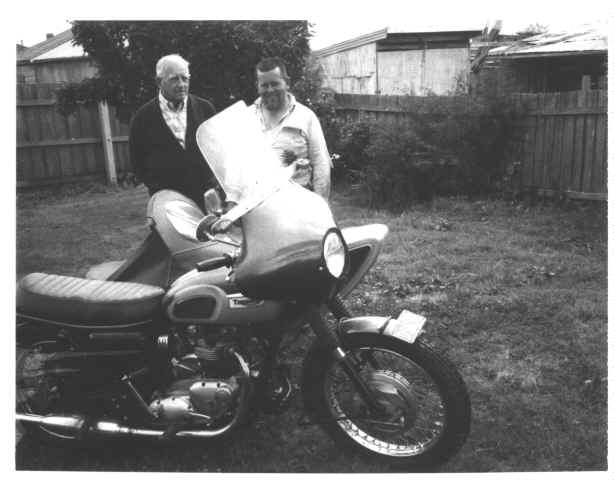
 The
picture at right shows the Triumph Trophy with Dusting sidecar with
my Grandfather, Helge Abrahmsen, and myself standing behind it.
The picture was taken sometime after the Dusting had been repainted
to match the triumph. Original canvas sidecar windscreen had
been replaced by a new black vinyl one. Ex-police fibreglass
handlebar fairing had also been painted to match.
The
picture at right shows the Triumph Trophy with Dusting sidecar with
my Grandfather, Helge Abrahmsen, and myself standing behind it.
The picture was taken sometime after the Dusting had been repainted
to match the triumph. Original canvas sidecar windscreen had
been replaced by a new black vinyl one. Ex-police fibreglass
handlebar fairing had also been painted to match.
Early in its
life I decided that the Dusting sidecar, although its 1946 black
paint with white pinstriping still looked brand new, ought to be
painted to match the metallic red and silver of the Triumph. I
had also fitted a police-style handlebar fairing and felt it would
look good painted to match as well. I carefully drew up
everything and designed the colour scheme and pinstriping details
that I wanted. First I had the fairing and sidecar sprayed and
then it was time to do the pinstriping.
Pinstriping the Dusting
Sidecar. One week, shortly after the new paint job
was completed, I rode to Melbourne where I met the then elderly
Vic Bogner who originally used to pinstripe the new Dusting sidecars
for Harry Dusting. I asked him to teach me how to do it and he
painstakingly did so. To see my metallic red and silver Dusting
with its beautiful gold pinstriping, just as I had planned it
following the original Dusting pattern, was an unforgettable sight.
I soon got the job of pinstriping other Dustings and a few other
vintage vehicles ended up with Dusting style pinstriping during the
ensuing years. The last Dusting I pinstriped was more than
thirty years ago, but I would love to get my hands on one today just
to check that I haven't lost any of that skill ... and maybe to teach
some much younger person how Vic used to do it before I in turn get
too old!
During the year I served as the Headmaster at Dumbalk North, the
Triumph-Dusting outfit was my "principal" mode of transport
(pun was not originally intended, but it's a good one so I'll leave
it there and add quotation marks!). During the times of
re-boring, re-sleeving and other work that it needed during its early
days, I rode a plethora of borrowed bikes, sometimes for a fortnight
or three weeks at a time. Some of these are long since
forgotten, but some rate a special mention below.
June 1969: The earthquake.
The Triumph was purring along contentedly at about 80 or 90 km/h
along a flat, long, straight stretch of the back road to Boolara at
about 04:00 or 04:30 early on a Monday morning in June 1969. I
glanced over to the left at the sidecar mudguard light which was
keeping me company. As I turned my attention back to the road
ahead of me which was very well illuminated by the high beam of the
Lucas headlight, there suddenly appeared to be a hump in the road
ahead. There was certainly no hump there yesterday! Suddenly
the hump was much closer than I had thought it had been. Next
second I felt the outfit rise and fall, rise and fall. There
had been two humps. On a previously flat road! And why had the
humps apparently been moving from South to North at some considerable
speed? I wondered about these strange "moving humps"
as I left the flat and wound up through the mountains. An
Earthquake had been felt in that area late on Saturday night.
Could those humps have been some sort of wave caused by the
eartquake? But why would they be seen and felt thirty hours
later? My scientific mind was working overtime. Just as well I
knew every inch of this road like the back of my hand. I
rounded a sharp curve to the right and straightened up again to the
sight of there being no road visible in my headlight! Before I
could even think of braking, the outfit was airborne. Then
crunch! The suspension bottommed out as she landed on a steeply
sloping patch of the road. Then airborne again this time flying
through the darkness with my headlight pointing up into the tops of
the gum trees. Then crunch again as the suspension bottommed
out a second time as the outfit landed heavily upon the road which
now looked roughly like it should have looked. I braked the
Triumph to an emergency stop, turned it 180 degrees and started to
slowly proceed back towards my recent breathtaking roller-coaster
ride. There I saw that a section of road had fallen below the
level of the rest of the road and formed quite a steep ramp sloping
upwards towards the South. As I looked at it I realised that
the Lord had been looking after me: had I been riding in the opposite
direction, towards the North, I would have written off the outfit as
the front wheel and forks would have collapsed and the nose of the
sidecar would have buried itself into the broken remains of the road
on the north side of the slab of road which had fallen. I still
couldn't figure out how a road that had been perfectly okay yesterday
could have been so badly damaged by this morning. As I stood
there wondering about this, there was a very deep and dreadful
roaring sound which came from beneath my feet and the ground started
to rock and shiver just as it had during Saturday night's
earthquake. This was accompanied by flashes like lightning from
the broken ground where the road had collapsed. To this day I
am still not sure about this ... was my mind playing some sort of
tricks on me to get me out of there, or did these flashes really
happen? As rocks and stones started to tumble down the
mountainside and land all around me, I leapt back on the Triumph,
spun it around, and headed off flat-out down the hill to get clear of
the mountain. Later that day, when scientists arrived to
invesigate the earthquakes, I learned that there had indeed been two
periods of aftershock activity recorded that morning and the first of
these must have caused my "moving humps" which I saw near
Boolara and the landslide which had taken the foundations out from
underneath the road where I had had my roller coaster ride, and the
second had caused the dreadful noise and rockfall which occurred
while I was standing looking at the damage caused by the first one.
I think this earthquake incident was probably the scariest thing that
ever occurred to me in all my years of riding motorbikes and
sidecars.
The enormous Double-Adult sidecar.
Some time after my year at Dumbalk North, I was teaching at
Yallourn Primary School and the Triumph was still my main transport.
Now I had from time to time read in British magazines about the
existence of double-adult sidecars although I had never actually seen
one. But I read a classified ad which told me that a
Double-Adult sidecar was for sale in Glenroy, a Northern suburb of
Melbourne. On the phone I learned that it was a body with no
chassis and I would need my own chassis. So I decided it
wouldn't do any harm to go and have a look and there it was, red and
huge. I have forgotten what it was built from, whether it was
particle-board or just a heavy wooden frame covered with plywood.
Its shape was roughly a cuboid, about 2.5 metres long, about 70 or 80
centimetres wide and about 50 or 60 centimetres deep. Its nose
was rounded in a semicircular shape and was sloped backwards
slightly. The mudguard was a standard Dusting item but was
mounted directly on the side of the body, since the body was much
wider than a standard Dusting body. Underneath the floor, to
mount it between the springs on the dusting chassis, it had raised
platforms (actually just great big blocks of timber) about 40 cm by
15 cm by 10 cm and needed very long coach bolts to mount it to the
chassis bars. I decided to purchase it and came back with my
Triumph and just the chassis of the Dusting chair. It had one
seat behind the other; both seats were enormous in size, and the back
of the forward seat could be removed in case one wanted to sleep in
the sidecar. We fitted the enormous sidecar and I rode back to
Morwell. By the time I reached Dandenong I pulled out my
screwdrivers and removed the large sidecar windscreen just to cut
down on the wind resistance a bit. You would think I had
learned my lesson with my "Yellow Coffin" a few years
earlier, but my reasoning went something like: "this motor is
much bigger and more powerful than the Yamaha YDS3, so it ought to be
able to handle it." But by the time I arrived home in
Morwell, I think I already knew that it was just too big and heavy.
For the first week I owned it, I rode it about without once taking a
passenger in it anywhere at all.
Six kids in the sidecar! ... Next
weekend someone suggested that I take the kids for a ride around town
since I had such an enormous sidecar. Thus it was that we
lifted the front seat divider a little and moved the seat cushion
rearwards halfway into the rear compartment. Then we rounded up
most of my siblings. two kids were seated side by side on the
front half of the front seat leaning against the front of the
backrest, two kids were seated side by side normally in the back
seat, and two more kids were seated facing backwards on the back half
of the front seat leaning against the back of the front backrest.
My sister got on the pillion seat behind me. Thus it was that I
drove for a couple of laps of the main street of Morwell with a total
of eight people on board my motorbike and sidecar and everyone of
them correctly and legally seated, which was verified by the local
constabulary who decided that this contraption was well worth having
a close look at. We actually ended up with about four carloads
of police and a couple of police motorcyclists checking us out that
afternoon. They were all of the opinion that, although it was a
perfectly legal transport for eight people, that I was likely to have
a very short clutch life. One policeman's estimation was that
the total outfit with eight people on board weighed somewhere between
a half and three-quarters of a ton. I have done the mental
calculation myself a few times since and I reckon he was right.
You should have seen how many heads turned that day as we lapped the
main drag!
The queen-size bed on the sidecar! ... Now
it just so happened that about a week or two before I bought the D/A
sidecar, Mum and Dad had purchased a new bed. The old bed was
in the passage blocking up the house and we thought, "How will
we ever get a Queen Sized bed to the rubbish dump?" It
wouldn't fit in the car; it would cost money to rent a truck; what
could we do with it? Dad and I looked at the bed, then looked
at the sidecar, then looked at each other ... could we do it?
Let's see how it looks if we just put it across the bike. The
mattress was nice and soft ... it wouldn't hurt the bike or the
sidecar, would it? If it could carry eight people around the
town yesterday, surely it could carry a Queen-size bed today!
Later that day, there was seen heading out Latrobe Road towards
the rubbish tip one Triumph motorcycle and double-adult sidecar with
a queen-sized bed ocky-strapped upside-down across the sidecar and
across the seat of the bike. Now, who do you think should come
along, but the local police! The policeman shouted to me as I
drove along, "Smithy, I don't know if that is legal; I don't
even want to know if that is legal; I am going to pretend that
I never saw it; but for goodness sake don't run into anything between
here and the Tip!" To ride the machine with this load,
there was no seat available at all since the bed was over it, so I
was riding in a standing position straddling the front of the fuel
tank with the fuel filler cap poking me in the bottom and riding it
as though it were a trials bike. My brother was following on
his motorbike, and when we reached the tip we carefully unloaded the
bed and chucked it on the rubbish pile and rode the two bikes back
home. The huge sidecar body was removed and stored and I think
we never used it again. The faithful old fish-box or the
genuine Dusting were sufficient after that.
If I remember correctly that double-adult sidecar was eventually
sold or given to someone who was going to put it on either a Harley
or an Indian.
The Tornado at Tom's Bridge.
Click the link to read about storm chasing on the Triumph outfit.
The Best Prepared Motorcycle and Sidecar at the Southern
Cross Rally. Since 1966, I had developed the habit of
getting to every motorbike rally that I could possibly get to.
I cannot remember for certain which year it was, but one year I
decided it was time to attempt to win the trophy for "The Best
Prepared Motor Cycle and Sidecar" which was awarded every year
at the Southern Cross Rally near Adeliade. I removed the "Fish
Box" and fitted the beautifully painted Dusting body onto the
chassis. I polished the Triumph and the Dusting before leaving
home and put plenty of polishing and cleaning gear in the sidecar
with my camping gear. On the way to the rally, at one point in
Western Victoria, I noticed that the next three vehicles in front of
me were sidecars and that the first two vehicles in my rear-view
mirror were also sidecars. I think that was the only time I
ever saw six motorbikes and sidecars in a row on the road without any
of them having planned to ride together. From the time I
arrived at the Mount Barker Showgrounds in the Adelaide Hills, I got
busy cleaning and polishing until every part of that outfit shone
better than if it had just left the factory. At the judging, my
hard work was repaid when I was able to take home the trophy.
Six sidecars in a row: After leaving Horsham on
the way to the Southern Cross Rally, just as I was approaching
Pimpinio, I noticed another motorcycle and sidecar way off in the
distance ahead of me. Not wishing to over-stress the Triumph I
did not change speed, but rather hoped that I might meet the rider
further along the road. By the time I reached Wail, he was out
of sight so I more or less forgot about him. While approaching
Dimboola, however, I saw him way off in the distance again.
Unfortunately I had to stop for fuel at Dimboola, but was soon back
out on the road again. Between Gerang Gerung and Kiata, I again
came within sight of not one, but two sidecar outfits up in front!
I couldn't resist! I opened the throttle just a tad higher,
hoping to catch them up. By the time we passed through Nhill, I
could see not two, but three sidecar outfits up front! Then I
glanced in the rear-view mirror and there was another sidecar outfit
behind me. Well before reaching Kaniva, I could see two outfits
behind me and I had caught up with the three outfits in front.
That made six sidecar outfits all in a straight line following each
other along the same portion of road; my Triumph was number four.
Now there were at that time, if I recall correctly, fewer than 600
sidecars registered in the entire State of Victoria. What the
odds would be against six of those outfits becoming the six
consecutive vehicles travelling along a lonely country road, when not
one of us had planned to be travelling together, I cannot even hazard
a guess. We all pulled up and stopped near Kaniva and had a bit
of a chin-wag. All riders were headed to the Southern Cross
Rally, and all decided that it was almost spooky to find six sidecars
all travelling together in a line like that. After a short
chin-wag, we all mounted our outfits again and headed off towards the
South Australian border. As we were all choosing to travel at
our own most comfortable pace, we never met again like that until we
were all at the rally. I saw different members of the group
again at various points along the way, but we never again formed up
into a six-in-line formation. A strange incident to be
remembering in such detail after all these years, but it was
certainly an unforgettable incident of my motorcycling carrer.
Piston broke at Horsham! On
the way home from the Southern Cross Rally, somewhere near Horsham,
there was an explosive Bang from the engine and the bike went into an
instant skid with the back wheel locked up. I pulled the clutch
and rolled to a silent halt. Who should be coming along the
road at that very moment but Alwyn Sobey my friend of many years from
my Ballarat Rovers Motor Cycle Club days who, although we were not
riding together, nor had we planned to be in the same part of the
country at the same time, just happened to be right behind me
on his BMW Steib outfit. He pulled up and got out a tow rope
and towed me all the way to Ballarat. There we put the bike in
for repairs while I stayed at Sobe's place. It turned out that
the cap had broken off the left piston at the top ring land and that
as the piston went down in the cylinder, the broken top flipped onto
its side, so that as the piston rose on its next revolution it hit
the piston cap and stopped dead, bending the connecting rod and the
crankshaft. If I remember correctly, I borrowed somebody else's
bike for a week and came back to Ballarat a week later to pick up my
outfit with its newly-rebuilt engine. I seem to remember that
it was only a short time after that, that the Triumph developed
further engine trouble. I had to admit that my dad was right
... that the Trumpy was keeping me poor because it just wasn't a good
enough bike to pull a sidecar all the time. I started to think
I wanted a trouble-free Japanese bike again.
Negotiating for the Suzuki-Watsonian outfit ... Now
at the Southern Cross Rally I had seen a very impressive 196cc Suzuki
two-stroke twin fitted with a Watsonian Bambini sidecar. It was
a demonstration model owned by one of the motorbike shops in downtown
Adelaide. It seemed to be beautifully balanced, definitely
looked appealing, and being a simple two-stroke, it should be a much
more reliable sidecar bike than the Triumph. I commenced
negotiations by letter and phone with the shop in Adelaide.
Yes, the bike was for sale. Yes, I could get a good discount
because it had been used as a demo model. No, they definitely
would not accept a Triumph outfit or solo as a trade in. They
would accept any Honda, Suzuki, Kawasaki, or Yamaha solo bike as a
trade in. I didn't have one of those... But the Triumph
was going to have to go. The Dusting was removed and fitted to
a Harley.
1969: The borrowed 1957 Yamaha
YD1 250cc with the single speed gearing
Now I promised above, to talk about the most memorable of the
temporary borrowed bikes that I used while the Triumph was in being
repaired. On one of these occasions Noel Einsiedel loaned me a
250cc Yamaha twin of mid fifties vintage. Its engine number commenced
with "D1-" which means it was manufactured in 1957.
It had leading link front forks with some sort of Harley-like
undamped springing system hidden behind pressed steel shrouds.
On Yamaha bikes of that era, the change to telescopic forks had not
yet arrived. It had a 1930's-style pressed steel chassis to
which everything else was bolted. The gearbox was cast in one
piece with the crankcase, so it was "modern" in some
aspects, but very "vintage" in others. Noel warned
me that the bike had a dicey gear change and if the gears broke,
don't worry about it "You'll figure out how to ride it
anyway!" Well, the gear selectors did fail, and the
gear-change shaft broke right off at the engine casing, so I threw
the gear lever and broken piece of shaft into the pannier bag, pulled
off the side of the gearbox and manipulated the gears into Third
Gear, and put it all back together again. Either just before
or just after the gear change failure, the kick starter also broke
and was also placed in the pannier so it could be taken back to
Noel. Thus it was that I found myself the rider of a
single-speed bump-start Yamaha. The badge on the tank read
"Yamaha ... since 1887" wrapped around a symbol of three
crossed tuning forks. As I bump started it, it felt more like
riding an 1880's model than a 1950's model! This bike had a
quadrant-mounted ignition advance-retard lever mounted on the left
handlebar. That lever was essential during the following weeks
as I travelled the steep and winding mountain roads with only a
single-speed gearbox. There was nowhere I couldn't take that
bike even though I only had third gear. By correctly adjusting
the ignition timing on the fly I was able to operate that two-stroke
at what must have been the lowest engine speed I think I ever heard a
two-stroke engine operating at. As its compression ratio would
have been only about 5:1, it was a very flexible if not very powerful
engine.
1970?: The second 1936
Harley-Davidson 1300cc Side Valve V-twin
Now as the owner of a Harley that was gradually getting worked on
occasionally, it became generally known around the district that I
was interested in Harley motorbikes. One day somebody told me
that there were rumours that somewhere up around Thorpdale-Gormandale
area, a Harley had been hidden in a farmer's shed so that it would
not be commandeered for use by the army during the Second World War.
I tracked down those rumours over the months until I had figured out
what farm the bike was supposed to be on. The bloke who owned
the farm at that time had been told about the bike when he had bought
the farm, but since the blokes that hid the bike had both been killed
in the War, nobody now knew where they had hidden the bike. I
asked for and received his permission to look around and my practiced
surveyor's eye noticed what nobody else had seen ... there was a wall
in between two sheds that faced in opposite directions and both sides
of the wall had the planks nailed on that side ... that is, there was
no "front" and "back" side to this wall, both
sides were the "front" side. As I looked at the sheds
on both sides I realised that the wall must have been about 50 to 60
centimetres thick. I asked permission to remove the planking
from the wall, and voila! there stood the Harley, all nicely greased
and oiled and with the handlebars removed so that the hiding space
could be much narrower. I paid the farmer for it, fixed the
handlebars in the correct position, cleaned it up, pumped oil into
the crankcase using the tank-mounted hand-operated oil pump, pumped
up the tyres and put my trail-bike 6-volt battery in place of the
huge Harley battery. Checked the spark plugs ... good spark!
Put a cupful or two of petrol in the tank and cranked the motor to
draw in petrol. Turned on the ignition switch and kicked the motor
slowly over to get everything lined up right for the good kick.
It never needed the second kick! The motor sprang to life on the
first preparatory kick.
I rode it from Gormandale directly to the police station where it
passed inspection and was registered that very same day. The
registration number was GG-008. I rode it to Bairnsdale to
visit my folks. Not a problem. It was an almost brand-new
bike even though it was more than three decades old. I fitted
the Dusting sidecar to it and it gave me many, many trouble-free
miles. It was my second bike for many years.
Now 1936 Harleys were blessed with two twist-grip controls.
The one on the right hand handlebar worked the throttle just like any
other bike. The one on the left hand handlebar worked the
ignition advance and retard system. If you got the engine
revved up and rolling along pretty well, closed the throttle and
immediately retarded the ignition, the result was an incredible
string of backfires through the exhaust system. I don't know
how good it was for the engine, but I sure loved the noise it made!
The Coach Road hill above the town of Yallourn was on the short-cut
between Newborough and Yallourn. It was a steep hill and just
seemed to be begging me to do the closed throttle and retarded
ignition trick. One night I did it and the police were called
by worried residents to investigate a supposed shooting match going
on between gangs somewhere in the bush up the Coach Road Hill.
I read in the paper that the police couldn't find a trace of these
supposed gang members. Next week, while riding back from
Newborough, I just couldn't resist the temptation, so I did it again.
Again the police were called out. As I realised that
policemen no longer seemed to be as forgiving as they had been in
"the old days", I decided not to push my luck by doing it
any more.
 The
Gippsland Historical Automobile Club was founded in 1968 and
was open to membership for any people owning or interested in
Veteran, Vintage, or Classic motor vehicles. A Veteran vehicle
was any motor vehicle manufactured prior to 1919, a Vintage vehicle
was any motor vehicle manufactured from 1919 to 1930, and a Classic
vehicle was any motor vehicle manufactured from 1931 until 25 years
before the current date. There was much discussion about
whether there ought to be a cut-off date for Classic vehicles at the
end of 1942. The GHAC was a very new organisation only a few
months old when I joined it in the 1960's although I was not a
foundation member. My 1936 Harley-Davidson motorcycles
qualified me to be a member, and I thoroughly enjoyed the fellowship
and camaraderie as we all helped each other with our elderly
vehicles.
The
Gippsland Historical Automobile Club was founded in 1968 and
was open to membership for any people owning or interested in
Veteran, Vintage, or Classic motor vehicles. A Veteran vehicle
was any motor vehicle manufactured prior to 1919, a Vintage vehicle
was any motor vehicle manufactured from 1919 to 1930, and a Classic
vehicle was any motor vehicle manufactured from 1931 until 25 years
before the current date. There was much discussion about
whether there ought to be a cut-off date for Classic vehicles at the
end of 1942. The GHAC was a very new organisation only a few
months old when I joined it in the 1960's although I was not a
foundation member. My 1936 Harley-Davidson motorcycles
qualified me to be a member, and I thoroughly enjoyed the fellowship
and camaraderie as we all helped each other with our elderly
vehicles.
The Morwell Motorcycle Club was primarily
interested in racing: scrambles (motocrosse), flat-track, speedway,
grass-track, road racing. I joined in about 1969 and took part
in various events until about 1973. More below to be added
later.
1970? The Suzuki T200
196cc 2stroke twin with Watsonian Bambini sidecar.
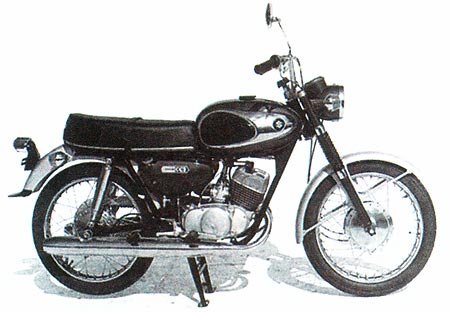
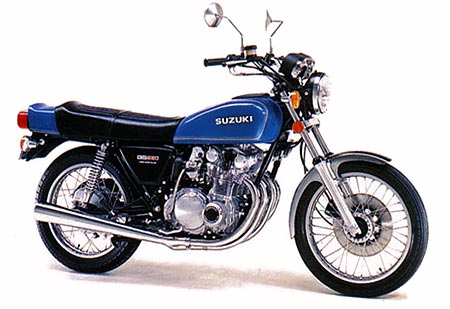
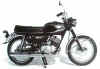 The
photo at the right is not my bike, but to all intents and purposes it
looks the same.
The
photo at the right is not my bike, but to all intents and purposes it
looks the same.
I rode my Triumph in solo trim (that is, without a sidecar) to
Geelong and traded it in on a second-hand single cylinder Japanese
bike. I think it was a Kawasaki, Suzuki or Honda of about
125cc. I can't remember: it's sole purpose was to transport me
to Adelaide where it was to be traded in on the Suzuki-Watsonian
outfit which I mentioned above. I remember the long slow ride
to Adelaide the most memorable part of which was looking in my
rear-view mirror and seeing that there was a comet behind me. I
stopped the bike and stood there by the roadside in the pre-dawn
early morning and stared at the beautiful sight of a bright comet in
the Eastern sky standing on its head which pointed towards the sun
which was still well below the horizon.
In Adelaide I arrived at
the dealer's premises before he actually opened for the day, but he
soon arrived, and we exchanged bikes and money and did all the
necessary paperwork and I headed back towards Victoria that same
day.
Re-wiring the sidecar: The wiring of
the sidecar looked kind of ugly when I got it home: wires were kind
of festooned everywhere and fixed in some places with a motley
assortment of metal and plastic clips, in other places with yellow
plastic tape. My inventor's mind became very active. I
looked over the design of the sidecar and decided that I could design
the perfect wiring loom. After a few careful measurements I
went to Coles and purchased an ordinary household three pin 240 volts
AC extension cord and promptly cut it in half. I removed the
sidecar from the bike, poked some fencing wire through the sidecar
mounting chassis under the bike and then pulled half of the household
extension cord through the chassis so that the female socket end was
flush with where the sidecar would be mounted back on, but inside its
main tube. I removed the body from the sidecar and pulled the
other half of the extension lead all the way through the sidecar
chassis until the end of the cord came out of the topmost tube of the
sidecar's suspension mounting where it would be absolutely hidden
from sight inside the sidecar mudguard. At this stage the male
three-pin plug of the cord was flush with the mounting point where
the sidecar would mount to the bike but completely inside its main
tube. I stripped a lot of parts off the bike and ran the
extension cord up the inside the frame fastening it in the same
clamps as the original Suzuki wiring loom. Where it passed the
battery case I made a tiny incision in the outer rubber covering of
the cord and pulled out a loop of the green earth wire from inside
the cord. I bared a little of the cable, soldered on a round
terminal and fastened it to the main earth mounting point beside the
battery. The rest of the cord was fastened totally out of sight
following the clamps holding the Suzuki wiring loom to the tail-light
mounting area where all of the existing wiring was joined with male
and female brass connectors under the cover near the taillight.
I soldered one male and one female connector to the end of each wire
of the cord and inserted them between the connectors to the taillight
and the left turning indicator of the bike. I left the left
turning indicator disconnected. Thus the whole of the wiring on
the bike was invisible. When I fitted the sidecar back to the
bike I simply pushed the three-pin plug into the three-pin socket and
both were immediately swallowed up inside the tubular mounting
hardware. On the sidecar, I removed the upholstery and did a
very neat wiring job from the front and rear turning indicators and
the running light and the tail light all hidden from sight behind the
upholstery and passing through a tiny hole in the body to the inside
of the sidecar mudguard. Inside the mudguard, I soldered brass
connectors so that the body could easily be removed from the sidecar
if required at a later date. At rallies I was asked dozens of
times, "How does your sidecar lighting work? ... there is no
wiring for it!" I lost count of the number of times that I
had to describe my invention. It was always so thrilling after
I looked at all the other beautiful sidecar outfits at various bike
rallies with their beauty marred by the legally required but very
ugly wiring harness to then look back at the Suzuki which had not a
wire in sight.
My first Sidecar Bingle: One day I was riding
through one of Melbourne's Eastern suburbs on the Suzuki-Watsonian
with my sister Julie in the sidecar. We were searching for a
street which should have come up soon on the right hand side.
Street signs were often missing, or bent or rusty and were therefore
often difficult or impossible to read. What I should have done
was pull over to the side of the road, identify a side street, get
the Melways directory from Julie and count the number of streets to
the one we were looking for. But it is always easy to be wise
after the event. While trying to make out a street name on a
rusty sign, I was distracted from watching the road ahead. I
looked back at the road and there, right in front of me, was a
stationary car that had pulled into the centre of the road ready to
make a right hand turn. I applied both brakes hard, but a
sidecar outfit has a much longer stopping distance than a solo bike
and I quickly realised that I wasn't going to make it. In
retrospect I realise that I should have not braked at all, but
wrenched the handlebars hard left and then hard right and I would
probably have missed the car altogether. But as it was, while I
lost most of my speed, finally I hit the rear of the car with
sufficient speed to send me straight up over the handlebars and I
landed on the roadway beside the car. As I did the "Commando
Roll" I had been taught while training for the Ballarat Rovers
Stunt Team years earlier, I was uninjured; not even a scratch.
My Sister, Julie was also almost uninjured, having slid right down
into the nose of the sidecar feet first. If I remember it correctly,
she had been wearing open sandals and received a small scratch on one
toe. It was a small enough injury to be "fixed" by
wrapping her hanky around it. The sidecar had dived in under
the rear of the car and both the nose and the windscreen mounting
were fractured. The front fork tubes were okay but had twisted
slightly in the triple clamps so that the handlebars pointed one way
while the front wheel of the bike pointed another.
I
straightened the forks and rode the bike the few blocks to our
destination. Then I rode it back to Morwell where the faithful
old white fish box was fitted to the sidecar chassis and the
Watsonian sidecar body and fairing took up residence on my bed.
It was only on my bed in the day time though! I went to the
library and borrowed books on repairing of fibreglass. I
learned that it was really called FRP (fibreglass reinforced Plastic)
and that I needed to purchase resin and hardener and fibreglass
matting and that repairing my sidecar should be a very easy matter.
About a week later both my sidecar body and the windscreen fairing
were back in perfect shape and ready to go to the paint shop. A
few days after that, they were fitted back in place beside the
Suzuki.
The Speed Test: Near home, they were
building a new freeway. The road was completed but not yet
opened. It was a dead straight downhill run of several
kilometres. There was a tail wind blowing. There was
enough room to get a little motorbike and sidecar around the
barricades and up onto the freeway. It was irresistable. Next
day I had taped a stopwatch to the handlebars. After a careful
look around for any sign of police cars, I sneaked around the
barricades and up onto the freeway. I tucked my head down as
low as it would go and lay down with my belly on the tank. I
wrapped it on and got that little 196cc engine going like it had
never gone before. I watched the speedo ... 80, 90, 100, ... it
just kept going. Then I noticed that the rev counter was
reading "Made in Japan" so I thought I ought to slow down a
little! I cannot now remember the measured speed I did, but it
was written up in Two Wheels magazine in late 1972 or early 1973, if
anyone still has a copy.
I rode that little outfit a great many miles, but I had a tendency
to thrash the guts out of it. It was never run without the
sidecar and it would spin up to high speeds, so as I was riding long
distances I tended to run it at high speeds. I used to ride the
Harley outfit quite a lot during those years as well, but I kind of
wanted to keep the Harley for later, so the poor little Suzuki was
mercilessly thrashed. It was a very light bike and I was a very
heavy man, so its suspension wasn't really good enough for the job -
especially when I carried passengers in the sidecar. The bike
was designed as a short trip around town commuter bike, not to do
interstate trips hauling a sidecar. The seat was designed to
just get you from home to work, and by the time I had been travelling
for five or six hours at a stretch, my bottom was very sore. My
father had taught me that it was always more interesting to get off
the beaten track instead of sticking to the main highways.
However the soft suspension on the little Suzuki would often bottom
out while riding on rough gravel roads.
I developed more and more of an interest in trail riding, but I
didn't have a trail bike. Lots of the fellows I met around town
came back from their trail rides with glowing reports of all the
wonderful scenery thay had travelled through. School teachers
are not made of money and I really couldn't afford to keep three
bikes registered and on the road, so if I wanted a trail bike then
the Suzuki would have to go. I bought a second hand DT1 250cc
2-stroke single trail bike, registration number CT-519, and sold the
Suzuki outfit for more than I had paid for it new, as it now had
"rare bike" value being the only motorcycle of its type in
Australia, as well as being fitted with the extremely rare Watsonian
Bambini sidecar.
1971?: The Yamaha DT1 250cc
2stroke single with Tilbrook Tom-Thumb sidecar.
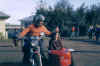
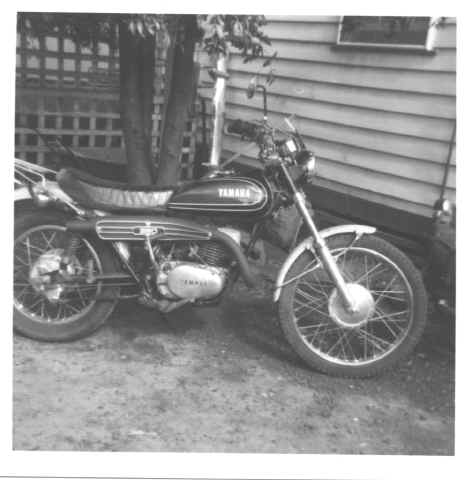
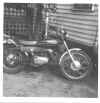 The
photograph on the right shows a later model Yamaha 250cc single trail
bike which was fairly similar to mine, but the one in the photograph
belonged to somebody else. Mine had a right side hand gear
change beside the fuel tank and had a wider and flatter luggage
rack. My colour scheme was also quite different.
The
photograph on the right shows a later model Yamaha 250cc single trail
bike which was fairly similar to mine, but the one in the photograph
belonged to somebody else. Mine had a right side hand gear
change beside the fuel tank and had a wider and flatter luggage
rack. My colour scheme was also quite different.
I took the Yamaha on a couple of trail rides, but it had something
missing. I was certain that trail riding would be much more fun
with a sidecar. A Tilbrook Tom Thumb was found and was fitted
to the bike with the help of my friend Gary Dunn who had a whole
workshop in his back shed at Churchill. The colour photo at
right shows a front view of my outfit not long after someone had
backed into it in a parking lot and put a ding in the nose of the
sidecar.
The frosty bridge. One weekend on a very frosty
morning about seven bikes were headed out from Moe to go for a trail
ride. I had the sidecar on the DT1 so when I saw that the
wooden-plank bridge had a thick coating of bright white frost I just
kept right on going without even thinking of slowing down. I
looked in my rear view mirror and saw all the solo bikes sliding in
all directions. Not a one of them managed to stay upright!
Fortunately, trail bikes are well-built and the riders wore thick
protective clothing, so neither motorbikes nor riders were injured at
all. This little incident reminded me again that the motorbike
and sidecar is one of the safest vehicles on the road, especially
when the road surface gets bad.
Mount Saint Gwinear. I'm not sure of the spelling
of this mountain, but it was covered in snow during the winter when a
group of us decided that we would try to reach the summit on our
motorbikes. As we climbed the snow became deeper and deeper and
I think all of the guys riding solo bikes fell off. I kept on
plodding along with the sidecar until, quite suddenly, a massive
snowball developed underneath the sidecar and lifted it. The
outfit rolled over to the right and I fell off into a deep
snowdrift. The throttle twistgrip was evidently jammed wide
open as the motor was screaming. I turned off the ignition and
the motor just kept screaming ... the spark plug and its coating of
the products of combustion was so hot that it was acting as a glow
plug - similar to those used in model aeroplane engines. I
quickly threw the bike back onto its wheels and gripped the brakes to
stall the engine. We made very slow progress as the snow became
deeper and deeper. The vehicle furthest up the road was a
four-wheel drive that had been abandoned totally bogged. The snow was
up to its windows. I was able to get the Yamaha only two or
three metres further than the four wheel drive before I decided it
was no use going on. It was just too much work digging out
mountains of snow. The biggest problem was the weight of the
bike which caused the tyres to sink down deep into the snow. It
was a day on which I wished the outfit had ultra-wide wheels. A
year or two later I figured out how to solve this problem - see
below. As the bike sank into the snow the floor of the sidecar
would rest on the surface of the snow and the outfit would simply tip
over. I think I rolled the outfit over more than a dozen times
that morning before deciding that the only way to the summit would be
to walk. A group of guys manhandled one of the solo bikes until
it was a few metres further up the mountain than my sidecar
just so I couldn't say that the sidecar could go where the solos
couldn't. We all had a lot of fun sliding down the mountain on
superphosphate bags for an hour or two; then we dug out our bikes and
headed back down towards civilisation.
Crossing the billabong on a log. My family moved
away from Morwell to Bairnsdale and I used to ride the outfit down
there to visit them whenever there were no trail rides on. One
day my brother Mick and I had the outfit down on the flats beside the
Mitchell River doing some bush-bashing. We came across a grassy
area bisected by a very long and narrow billabong. At one point
there was a log across the billabong and it was obvious from the
tracks through the grass that people were in the habit of using it as
a bridge to cross the billabong and thus take a shortcut. I
looked at it, walked back and forth across it and then announced to
my brother that I was going to ride the motorbike and sidecar accross
it. I pulled back a bit and built up a suitable amount of
speed, swung sharply left to lift the sidecar high in the air and
then, riding on two wheels at about a 45 degree angle I aimed the
bike at the log. I drove across the billabong on the log in
perfect safety. We decided this was worth recording, so Mick
got the camera ready and I went back and did it again. When I
was on the log about half-way across the billabong I lifted my left
hand from the handlebar and gave a cheery wave. The resulting
photo showed the outfit halfway across the billabong, sidecar high in
the air, and me waving away as though I did this every day of the
week. That photo eventually ended up in one of the motorcycle
magazines of those days ... perhaps it was the "Green Horror"
(Australian Motorcycle News) or maybe Two Wheels magazine.
Unfortunately I do not have a copy of it any more.
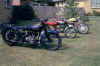 1971:
1925 Harley Davidson 1200cc F-Head V-Twin
1971:
1925 Harley Davidson 1200cc F-Head V-Twin
I did not own this bike, but assisted its owner Gary Dunn in its
restoration. I got to ride it a number of times while Gary was
waiting to get his motorbike licence so that he could ride it.
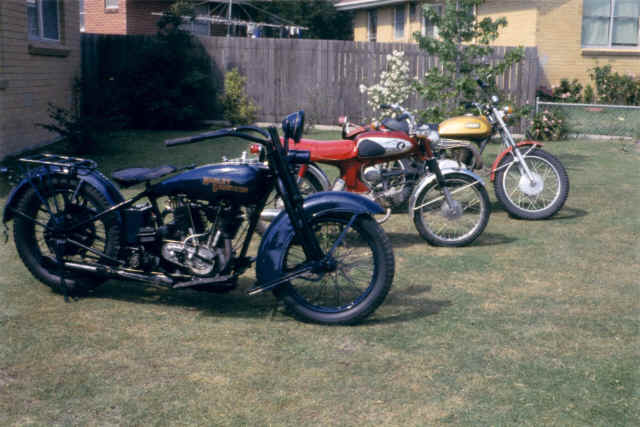
In the photo at right the Harley had been restored but its sidecar
was not yet fitted. Other bikes in the picture are a red Honda
90cc and my Yamaha DT1 250cc single before its sidecar had been
fitted. The blue Harley was certainly a head-turner wherever it
went. While the engine was running, the pushrods would be
reciprocating up and down beside the cylinders and you could watch
the rockers rocking and see the valve springs compressing as the
inlet valves were operating. It took me back to the dozens of
similar Harleys that made virtually all household deliveries when I
was a kid. The term "F-Head" means that the inlet
valve for each cylinder was placed exactly above the exhaust valve
and both valves were offset to the side of the cylinder. So the
exhaust valve was a "side-valve" and the inlet valve was
more or less an "overhead valve". The engine ran very
efficiently and well, but maintenance was much more time-consuming
than on the side-valve engines that later replaced them. Before
riding the Harley, at least once a week, it was necessary to use a
grease gun to grease the nipples on the valve rocker arms. In
fact there were grease nipples all over the bike that had to be
regularly attended to. The brakes on this bike were of special
interest. There was no braking on the front wheel or the
sidecar wheel at all. On the back wheel there was a narow drum
about 25mm wide which had two brakes working on it. There were
two brake pedals, one under the toe of your right boot near the front
of the right footboard and a second one to be operated by your right
heel at the rear of the right footboard. The front footbrake
operated an external contracting brake band which was around the
outside of the drum, while the other rear brake pedal operated an
internally expanding set of brake shoes which were inside the drum.
Actually, I cannot remember which pedal operated which brake, but one
certainly worked on each. The clutch was operated by the left
foot and the gear shift was operated by the left hand. Thus
this bike had very clean looking handlebars with no levers on them at
all. The right hand twist grip operated the throttle and was
the only control on the right handlebar. The left hand twist
grip operated the ignition timing which was advanced or retarded
manually by twisting the twist-grip as required. The other
control on the left handlebar was the horn button which operated a
significantly loud and commanding horn which was fitted below the
headlight on the front forks. If I recall correctly, I think we
added a suitably aged looking headlamp dipper switch to the right
handlebar and did the required re-wiring to fit a dual-filament bulb
inside the original headlamp as I am pretty sure there was not any
provision for dipping the headlamp when we bought the bike. The
"tank" was actually three separate tanks with three
separate filling caps. The left front cap filled the oil tank.
Lubrication was a total loss affair with a gear-operated external oil
pump fitted to the right hand side of the engine - it is clearly
visible in the photo. The hand-operated oil pump on the top of
the tank was for use under heavy going if the engine overheated, or
when putting the engine back into service after a long period of
inactivity. The second filler cap on the left side of the tank
filled a small "reserve" petrol tank. The main petrol
tank was filled through the filler on the right.
1972: Moto Guzzi 850cc OHV
V-twin
For many years, the fast wearing of the final drive chain had been
a real nuisance for me on all of the sidecar bikes I rode. I
often longed for a shaft drive but BMWs were too expensive for a
bloke like me who kept spending his money on all sorts of different
motorbikes on a very regular basis. Several times I looked at
the Russian M-series bikes ... shaft drive boxer twins of varoius
capacities which were advertised as "One dollar per cc",
thus a 500cc version was $500 and a 650cc version was $650 and so
on. The trouble was that no matter who I asked, I always got
the same response: "They will break down all the time and
you will never get parts for them." So I didn't purchase
one, although I rode several of them on test rides at different times
over the years.
Meanwhile, the Italian company Moto Guzzi
commenced marketing its bikes in Victoiria and shiny brochures became
available at the local motorbike shop. I looked through the
brochures and I liked what I saw. In particular, I liked the
promised 850cc touring bike which hadn't yet arrived in Australia and
ordered one off the brochure. I paid my deposit and waited and
waited and waited and waited. I was told, "Your bike will
arrive in March ... in May ... in July ... in September ..."
Eventually I received my shiny red brand new Moto Guzzi 850 just
before Christmas 1972. It was fitted with the white Craven
Dolomite panniers I had ordered and with a very large white handlebar
fairing and windscreen. My father dubbed it "the
two-wheeled car." A transverse V-twin, it had a great
gearbox and shaft drive, not to mention the luxury of an electric
starter. Most of the time I was so far within its performance
range that it was almost just idling along.
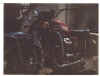
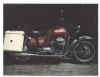 The
photos of my Guzzi at the right are taken from old colour polaroid
prints and the colours have darkened and become spotted during the
last thirty-odd years.
The
photos of my Guzzi at the right are taken from old colour polaroid
prints and the colours have darkened and become spotted during the
last thirty-odd years.
I had every intention of fitting a sidecar to it, but I wanted the
sidecar to be a new one. At that time there were two sidecar
manufacturers that I was aware of: Baja Sidecars who were North of
Albury if I recall correctly, and Twin-G Sidecars who were somewhere
in a suburb East of Melbourne. I think Murphy sidecars were
also being made in Sydney's Western Suburbs, but I didn't like the
shape of them. I considered both the Baja and the Twin-G and
decided on the Twin-G because of its better aerodynamic design.
The Baja was a wedge shape with a tall cut-off vertical rear wall;
I decided that its shape would create a great deal more drag than the
more streamlined-looking Twin-G. There was a problem ... if I
ordered a Twin-G, it would be several months before I worked my way
gradually up the waiting list and eventually got my ordered machine.
The guy hand made them one at a time and had a severe backlog of
orders. For a while I decided to enjoy riding it solo and did
not immediately order my Twin-G.
The Moto Guzzi was an ideal touring machine: very
comfortable, plenty of power, very wide power range, lots of room for
luggage (especially with the Craven carrier and panniers), and it
just had the feeling that you could ride on it for ever and
thoroughly enjoy it. I went to a couple of Rallies and on a few
other camping trips with it. I remember going to a rally held
in the Warrumbungle Ranges National Park where the road in was an
extremely rough clay road with boulders all over it and erosion ruts
a foot (30 cm) deep. I thought to myself that this road would
really suit my Yamaha trail bike better. But the big heavy Guzzi took
it all in its stride and I never fell off, even though I did not have
a sidecar. Many other touring bikes were seen lying on their
sides on the road where their owners had been bucked off by the
horrific road conditions.
I remember travelling from Mount
Beauty to Harrietville via the Tawonga Gap with a full load of
camping gear on board and scraping the centre stand of the bike on
every single curve of that magificent road. For anyone who
loves a winding ride on a solo bike, I can really recommend that road
as one of the best motorbike roads ever.
I remember the first
day I rode it at more than 100 mph. It was on a beautiful
straight stretch of the Princes Highway between Bairnsdale and
Stratford, and, since the engine was now fully run in, I decided to
open it up. It effortlessly wound up past the magical 160 km/h
mark to about 170 km/h where I decided that I really ought to roll
off the throttle a bit in case those gentlemen with the blue uniforms
decided to stretch amphometer tapes accross the road. Sure
enough, just as I got down to the legal speed limit, there were the
two black tapes across the road. I kind of grinned to myself as
I thought, "You guys just don't know what I was doing a mile or
so back along the highway."
The farm bike competition. One weekend
there was an advertised farm bike competition being held. I am
not sure of the venue, but I think it might have been at Gelantipy.
I rode up there for the day intending to be a spectator and enjoy the
competition. As I waited for things to start, it turned out
that very few farm bikes had actually arrived for the competition.
One of the organisers approached me and asked me to join the
competition on my Moto Guzzi 850cc V-twin. Now Agricultural
motor cycles are light, small machines specifically designed for the
kind of skills that were needed for this competition. My Guzzi
on the other hand was a heavyweight long-distance touring bike with
not much ground clearance, a huge pair of fibre-glass Craven Dolomite
panniers, an enormous handlebar-mounted touring fairing and
windscreen, and so on ... a far cry from a farm bike! I was
encouraged to enter so I shrugged my shoulders and thought it would
be fun trying, but not thinking I had a chance of completing the
course.
The first event involved riding up to a closed gate,
unfastening and opening the gate, riding through the gateway, closing
the gate behind you and correctly fastening it and then riding to the
finish line without putting a foot to the ground for balance.
Several competitors went througfh the course on Ag-bikes first and
they all put their foot on the ground at least once and lost points.
My turn came up and I went through on the Guzzi, did everything
faultlessly and didn't put a foot to the ground once. I won
that round easily!
The next event involved about six or seven
44-gallon drums which were placed on their side on the ground,
fastened in place by stakes. A ramp of wood was placed against
the first drum and the idea was that you had to ride over the whole
line of drums and off the other end, where there was no ramp, without
falling off your bike or putting the foot to the ground for balance.
This time I was asked to go first, so I put the Guzzi into gear,
straight up the ramp and bounced happily along the line of drums
without the slightest problem. As I approached the end of the
line of drums I lifted the front wheel in the air and did a neat jump
off the last drum and rode to the finish line. Again a
faultless performance. One or two of the farm bikes also
managed a faultless crossing of the drums, but most had to use their
feet for balance, and a couple of competitors fell off their bikes.
I
took part in all the other events that day and turned in a faultless
performance for the whole day. I won the slow race (where a
motorcycle has to be ridden as slowly as possible without putting
one's foot on the ground with the last bike to the finish line being
the winner) by miles ... I was about a quarter of the way along the
course when all of the other bikes had already crossed the finish
line. As everyone was getting sick of waiting for me when I had
obviously won so well, I mono-wheeled the last half of the course
just for fun. The reporter from the paper interviewed me and
asked me where I as a non-farming touring-bike rider had learned the
skills to be able to successfully herd sheep, ride over see-saws, and
all of those other interesting things. When I explained that I
had been a Stunt Rider for several years and that my stunt riding had
mainly been done on heavy Harley-Davidson machines, he kind of
understood how I had been able to pull it off. That week, there
was a great photo of my touring-equipped Moto Guzzi on the front page
of the Bairnsdale Advertiser along with a story about the
farm bike competition.
21st March 1973:
The night that changed my life.
When one is a qualified teacher, it is necessary throughout your
teaching career to continually update your qualifications. To
do this you attend courses of lectures held after school hours at
various venues around the district. In March 1973 I happened to
be attending a series of lectures held at the Grey Street Primary
School in Traralgon. On the 21st of March, at the end of the
lecture, I placed my books in the left pannier of my Moto Guzzi 850
and started to travel towards home along Church Street. I
stopped at Kay Street to look for traffic coming from the right;
there was nothing coming, so I crossed the first carriageway of Kay
Street and glanced briefly to the left before crossing the second
carriageway; I noticed the lights of a car approaching but it was
still quite some distance away and was required by law to give way to
all traffic on its right, which included me. As I crossed the
second carriageway, still in first gear, I suddenly noticed that the
car to my left was very much closer than I had supposed and that it
was in fact travelling at an extremely high speed ... and I was
already right in front of it!
There was a tremendous bang and I
found myself airborne, and I was thinking so quickly while in the air
that I was already aware that my left leg was broken, so I hooked my
right foot under it to try to prevent further damage before I hit the
road a little over 85 feet from the point of impact.
Apparently, when a motor car collides with a motorcycle from exactly
side on, the tyres attempt to stick to the road so that the body of
the motorcyle perorms an incredibly fast acceleration in a direction
away from the car that has just hit it. This acceleration acts
as a verty powerful catapult which sends the rider up into the air
and rapidly away from the scene of impact at a considerably faster
speed than the speed of the car. Thus, I landed on the road
well clear of both vehicles.
I was well aware that my left leg
was broken, and therefore I did not attempt to get up but waited
there on the roadway for the arrival of an ambulance. Now there
isn't exactly much you can occupy your time with while you are in
such a position so I looked around me and sized up the situation.
I could see my bike lying on its side and that all the contents
of my pannier boxes were strewn everywhere, and I could see that the
weight of my motorbike had pushed in the front of the car so that its
engine had been moved back into the passenger compartment. As I
considered the extent of the damage, especially to the car, I
marvelled that I hadn't been killed in the collision.
As I
considerd this, I looked around me and noticed that there were
churches located on three of the four corners of the intersection;
the fourth corner had a petrol station. And as I looked around
at the churches, the thought was planted in my mind: "God was
looking after you." Now at that prticular time I was
working hard at pretending that I didn't believe in God: I was trying
to be an atheist. The problem was, that this train of thought
wouldn't go away. Now this God I was trying not to believe in
was speaking in the first person: "Phil, I was looking after you
tonight!"
He was very persistent and wouldn't stop:
"I was looking after you ... My hand is upon you ... I will
never leave you nor forsake you ... I am looking after you."
No matter how much I tried to convince myself that I didn't believe
in God, He still continued to speak to me, until the ambulance
arrived.
I was taken to the Central Gippsland Hospital in
Traralgon, which became my "home away from home" during the
next several months.
I had to sign various forms during the
admission process, including forms for permission to use anaesthetics
etc., but there was one form which, when I looked at it, I
immediately heard the same voice which had spoken to me earlier in
the night while I had been waiting for the ambulance; it said, "Do
NOT give them permission to amputate that leg." So I did
not sign the amputation form. Over the next several months I
was in and out of hospital a number of times, had many minor
operations, and by mid-September I was back in for bone grafts and
skin grafts. I was still attempting to try to be an
atheist, but every time I tought back to the night of the collision,
that same voice would come back as if to haunt me: "I am looking
after you." Now I have always been an avid reader, and in
hospital there was not much to read, but there was a Gideons Bible
always there on my bedside table. I started to read it.
Sometimes when I would be in pain, I would look up the table in the
front which told me which references to read if I was in pain.
As soon as I would read those scriptures, the pain would mysteriously
vanish. As I read the Gospels, especially the Sermon on the Mount, I
found myself thinking, "Wouldn't the world be a fantastic place
if everybody in it observed these principles in their lives."
The little voice which was becoming more and more familiar would
immediately come back with, "Why don't you start with
yourself?"
In September a grader driver whose name I have
forgotten was brought into hospital after an accident and was placed
in the bed opposite mine. He talked about Jesus as though Jesus
was his best mate. He gave a tract to me which was titled: This
was Your Life. I read it through several
times and looked up all of the scripture references and read them in
context. I soon reached the point where I had decided that now
I knew how to be saved, that one of these days, sometime between now
and when I died, I really ought to give my life to Jesus Christ so
that I would have eternal life. But first there were too many
sinful things which I had never tried out that I would like to have a
go at first.
Perhaps the 10th September 1973 might have been the
loneliest day of my life. Here I was, stuck in hospital with my
leg up on a Braun's frame, eighty miles away from my nearest
relative, it was my 27th birthday and nobody was going to come and
visit me. The doctors had placed me on a strict 1000 calories
per day diet, so I couldn't even have a cake to celebrate on my own.
I suppose I was a bit depressed. I guess that was really the
most down day of my life.
However, Sister Petrovich had
evidently observed in my records that it was my birthday, as she
added a candle to one of the tasteless blobs of stuff that was part
of my diet and brought in a whole bunch of other nurses to sing
"Happy Birthday" to me. My feelings lifted upwards,
just a little bit. And three days later, wow!
There is a
fuller version of this part of the story on
http://www.drdisk.com.hk/PhilSmith/about.htm
for those interested, but to cut a long story short, at about 10
minutes past 12 midday on 13th September 1973, I
listened at last to that still small voice and asked Jesus Christ to
come into my life and to be my Saviour. I have not been the
same since. That's why I say that the 21st March 1973 was the
starting point of the biggest change in my life.
Modifying Bikes to Ride While Crippled: During
the months that I was on crutches, in between my visits to hospital
for more and more operations, I regularly rode two bikes: my Yamaha
250cc DT1 with Tilbrook Sidecar and my 1936 Harley Davidson with
Dusting sidecar. The first of these to be modified was the
Yamaha. The DT1 was made with the gear shifter shaft extending
through BOTH sides of the gearbox with a kind of plastic cap pressed
on over the right hand end of the shaft. Normally, of course,
the Yamaha, like any Japanese bike, had its gear change lever on the
left side end of this shaft and it was operated by the rider's left
foot. Now I found myself with my left leg encased in plaster
and no possibility at all of operating the gear change with my foot.
I got a second-hand gear lever, cut the pedal off it, and welded on a
length of straight chrome-plated pipe. I neatly fitted a rubber
bicycle handlebar grip over the end of the pipe and fastened it to
the right hand end of the gear shifter shaft. People would
really take a second look when they would see me changing gears with
a lever beside the right-hand side of my tank.
Modifying
the Harley for riding without a left leg was also a fairly simple
matter. The Harley's left foot control was the clutch, the
gear change being managed by the left hand using a lever which
operated in a gate on the left side of the fuel tank. Now this
bike had been built in the days before spring returns had been fitted
to throttles, clutches and the like, so these levers always stayed in
exactly the position in which you placed them. To modify the
foot clutch, I made a long handle out of a piece of steel strapping
recovered from the frame of a wrecked pram. Another short
length of the strapping was used to triangulate the fitting of the
hand lever to the normal foot clutch lever which was done with three
small bolts and nuts. Thus to change gears on the Harley, I
would use my left hand to pull the clutch lever fully back towards me
to disengage the clutch, let go the clutch lever and use my left hand
to change gears, and then use my left hand again to push the clutch
lever forward and away from me until the clutch was again engaged.
I remember taking my Harley to the Police Station in Yallourn to have
the modifications approved. The policeman said to me, "Hey
Smithy, we know you well enough to know you wouldn't even bring it
here unless it was perfectly safe to ride. ... We don't need to
inspect that bike to give you a safety certificate."
Having written out the certificate, he said, "Oh what the heck!
There's nothing much going on around here ... I have always wanted a
ride in a sidecar ... let's go out for a ride!" So he
hopped into the sidecar and I started the Harley and we rode around
the various streets of Yallourn, the policeman's grin being so wide
his ears nearly fell in!
Meanwhile the Moto Guzzi on which I had been riding on the night
that began to change my life was sitting in a corner of the workshop
behind Noel Einsiedel's shop. It was apparently extremely
difficult in those days to get spare parts for it. Month after
month after month it just sat there. Eventually Noel bought it
from me, so I don't know whether or not it was ever repaired.
Miracle on the road to Morwell
One Sunday at evening service at St Luke's Methodist Church in
Morwell a visiting preacher spoke on Hebrews 13:8 "Jesus Christ
the same yesterday, and to day, and for ever." and made the
claim that there was no miracle recorded in the Bible anywhere
between Genesis 1:1 and Revelation 22:20 that God could not do again
today if the occasion called for it.
Next day I read Acts
8:39-40, "And when they were come up out of the water, the
Spirit of the Lord caught away Philip, that the eunuch saw him no
more: and he went on his way rejoicing. But Philip was
found at Azotus: and passing through he preached in all the cities,
till he came to Cæsarea."
I thought to myself that
miraculous transportation from one physical location to another was
one miracle I had never ever heard of happening in the twentieth
century, so I prayed about it and asked the Lord to lead me to a book
in which I could read about such a modern day miracle. I did
not for even one moment suspect that he would make me the subject of
that book.
Now at that time, my daily transport was a single
cylinder 250cc Yamaha motorbike and sidecar which was painted in a
bright day-glo orange-red colour (which,
according to the Taubman’s paint company, was officially known
as "Boeing Red") and was so
eye-catching that everybody in my country district knew that machine
and knew who rode it. It was capable of just 35 mph (60 km/h)
or perhaps 40 mph (70 km/h) if I had a tail wind. Having a very
small fuel tank that held only about a gallon (3 or 4 litres), it was
necessary to stop every forty miles (70 km) or so for petrol.
At that same time I was a member of Christ's Crusaders Motorcycle
Club and had become well known for attempting to preach the gospel to
other motorbike riders such as the members of Hell's Angels and
Satan's Cavalry. At that time also I was a Lay Pastor in the St
Luke's Methodist parish at Morwell.
The following Sunday I was
not scheduled to do any preaching in the parish, but I was scheduled
to lead the opening worship at the 7pm (19:00) evening service.
I decided to visit my parents who lived in Bairnsdale, about 80 miles
(130 km) away. I had figured that if I left my parents' home
soon after lunch on the Sunday, I would have plenty of time to make
the 2½ or 3 hour journey back to Morwell, have some dinner, go
to the pre-service prayer meeting and then lead the opening worship.
"No worries!" I thought to myself.
About 3pm (15:00),
I pulled on my motorbike outer clothing and went out to the front of
my parents' house where my bike was parked at the side of the road on
Main Street. I checked my tyres, brakes, lights, oil level, and
petrol and, satisfied that all was in order for a safe trip to
Morwell, I kick-started the motor. I had already pulled in the
clutch and, just as I was about to push the hand gear-shift lever to
the right of the petrol tank forward to engage first gear, seven or
eight Harleys and Triumph motorbikes arrived and pulled up all around
me. I was receiving a surprise visit from several members of
Satan's Cavalry. I stopped the motor and started talking right
there on the street. They had lots of questions for me: "If
the God you preach is a God of love, how could He let all those
innocent people die in the train crash last week?" "If
God is really all powerful, how come he didn't stop that gang from
raping the pastor's daughter in Melbourne last month?" and so
on.
I patiently answered their questions as well as I could, yet
was also aware that time was ticking away. "I don't need
dinner when I get to Morwell," I reasoned with myself; and
a little later, "If I don't make the prayer meeting, it will be
all right, I can pray while I am riding along the road."
All this time, I had never seen these outlaw bikers, who would
normally make themselves scarce pretty soon after we started
preaching to them, so interested in asking and listening intently to
the answers to so many questions. "I am really getting
through to these guys at last," I thought to myself.
Eventually,
the questions ran out, and one of the guys announced, "Let's all
go to the pub for an hour or two."
I excused myself and
said I needed to get back to Morwell and started on my way. I
looked at my watch as I pulled on my gloves ... it was 17:45
(5:45pm). I had only an hour and a quarter to do a trip that
would normally take at least two and a half hours!
As I drove up
the road, I prayed that Richard or Pepe would realise that I wasn't
at the pre-service prayer time and step in and lead worship. I
was soon cruising along the highway at about 35 mph and felt
strangely peaceful about missing the evening church service.
When I was about seven or eight miles out of town I was on a nice
straight stretch of road with State Forests on both sides and was
thinking to myself how beautiful all the trees appeared in the
evening sunlight. Suddenly, almost without being aware of it, I
realised that I was approaching the railway crossing to the East of
Traralgon. I thought to myself, "I've been day-dreaming
while I was riding." "I can't remember any details
of any of the towns I went through along the way." "
I can't remember passing through Stratford." "Did I
cross the Avon River Bridge?" "Did I travel via Sale
or via Maffra?" "I have no recollection of passing
through Rosedale." "How come it's still daylight ...
it ought to be quite dark by now." "I cannot even
remember filling up with petrol."
I felt down to the petrol
tap, it was in the "Normal" position; I had not yet
switched to reserve. I thought to myself, "I must have
miss-read my watch when I was about to leave Bairnsdale."
I sang and prayed as I drove through Traralgon, up the hill past the
Hospital, and along the Prince's Highway to Morwell. As I
approached the traffic lights, I made the right turn into the St
Luke's Church car-park. I had missed the pre-service prayer
time, but was just in time to walk straight in and start the service,
still wearing all my motorbike gear. I put my helmet and gloves
in the lectern and started leading worship. As I led worship, I
noticed that a guy from Satan's Cavalry was in the service, not one
of the guys I had talked to in Bairnsdale, but a different
fellow.
After the service, he asked me, "How did you get
here?"
I responded, "What do you mean, how did I get
here ... by motorbike of course."
He continued, "Our
guys planned to foul up your day and make you real mad by missing
church tonight; they planned to hold you up in Bairnsdale."
I
ran to my bike and got out my petrol book (I was in the habit of
writing down in a Shell Driver's Log Book, every petrol stop I made:
the date and time, odometer reading, the amount of petrol I purchased
and how much it cost were all faithfully recorded.) The last
entry in my petrol book showed that I had filled it up at Bairnsdale
and I compared the odometer reading I had recorded with that on my
motorbike now: I had travelled only something like twenty miles
instead of eighty!
It was only then that I suddenly realised
that I had not miss-read my watch at Bairnsdale after all. The
Lord had worked a miracle of the transportation kind. He had
somehow moved my motorbike and sidecar and me from somewhere West of
Bairnsdale to somewhere East of Traralgon in just a moment.
Even saved me a tank full of petrol! I have no explanation of
how it was done. Mileage-wise, one could say I had loaded my
bike onto a trailer and carried it from one place to the other.
But that is not what happened. That week I was stopped several
times by members of Satan's Cavalry, "How did you get to church
on Sunday?" When I told them that the Lord had worked a
miracle, they just said I was nuts. A lot of people said I was
nuts, but I can only report what happened to me. You just have
to take it or leave it.
1973-1980 Christ's Crusaders
Motorcycle Club
In the section above titled "The night that changed my life"
I mentioned how, while I was in the Hospital in Traralgon, that I had
come to a full belief in the Lord Jesus Christ. The nursing
sister in charge of the Orthopædic ward for one shift of most
days was Sister Petrovich. She seemed to be the only one who
really understood why I was going around the ward madly trying to
tell everybody about Jesus. A day or so after my life changing
experience, she asked me whether she could ask her husband and his
friends to come and visit me in hospital. Now hospital can be a
pretty boring place when your nearest relatives live eighty miles
away, so I responded, "Sure, why not!"
It was
Saturday, I think, when Pepe Petrovich and a half dozen other fellows
all dressed in their motorbike gear came in to see me. We
talked for a while and I began to be very excited about the vision
that Pepe had for bringing the gospel to guys on motorbikes.
The group was called "Christ's Crusaders" and they wore
outlaw-style patches on their jackets. They met every Thursday
night in a "den" behind the hall of St Luke's Methodist
Church in Morwell. Although their meeting place was at St
Luke's, I was hastily assured that not all of the members of the club
were from St Luke's church. Gordon belonged to the Church of Christ,
and someone else was from another church as well.
I made up my
mind during that very first visit, that one day, when I was out of
hospital, I would join Christ's Crusaders.
The first Thursday I
was out of hospital, I rode around to where all the motorbikes were
parked at the rear of St Luke's, parked my bike, and hobbled along on
my crutches to "The Den".
I thoroughly enjoyed my
first meeting and rarely missed one thereafter. At the meetings
we would sing, pray for each other, and share testimonies about the
wonderful things Jesus was doing in each of our lives. Somebody
would bring some teaching from the Bible and many times there would
be prophecies or gifts of speaking in tongues followed by
Interpretation. We witnessed healings and heard testimonies
about many wonderful miracles that the Lord had worked as the members
prayed. These were really exciting days.
Every now and
again we would welcome a new member. Some of these guys had
been members of Satan's Cavalry that had come to know Christ.
Others were just ordinary everyday Joe Blow motorbike riders whom we
met around town and started talking to and who then decided to
acknowledge that Jesus was their Lord.
The club existed to enjoy
riding their motorbikes and enjoy serving the Lord at the same
time.
We used to plan to travel together to some of the annual
motorcycle rallies held in various states and we also arranged to
conduct worship services on the Sunday mornings at those
rallies.
Many weekends, we would also be asked to conduct church
services or youth fellowship meetings in churches throughout
Gippsland.
After I had been attending for some months the
existing "Patch Wearers" had a meeting at which they
decided to make me a Patch Wearer and I was issued with my
patch.
After a year or so, Pepe Petrovich who was the leader of
Christ's Crusaders, felt that the time had come to devote more time
to looking after his growing family and decided to step down.
The club went away for a weekend retreat and decided that I was to
become the new leader. I held this position until I was married
in February 1976 and moved away from Morwell, at which time I handed
on the leadership to Joe Tettman.
Christ's Crusaders "raid"
Satan's Cavalry. The Harley "shotgun"
One of the really fun times we had with Christ's Crusaders, was
the night we decided to "raid" the Satan's Cavalry meeting
which was being held at their "secret hideout." It
came about like this. Years earlier, my family had rented a
farmhouse on River Road at Tyers as our family home from one Mr
George Baillie. Our family had moved away from there in 1965.
One day I met George Baillie while he was delivering eggs and decided
to stop for a talk. He mentioned that he was now renting his
house to "some of your mates." It turned out that he
meant by this that a motorcycle club had rented the house in order to
hold their meetings there. The club turned out to be Satan's
Cavalry. Completely oblivious to the fact that the club's
meeting place was supposed to be a closely guarded secret, George
went on to explain exactly which days each week that they met there
and at which times.
Knowing that Satan's Cavalry kept their
meeting place a secret, I went to my next Christ's Crusaders meeting
armed with this knowledge. We quickly arranged to meet together
and go out to visit Satan's Cavalry at their meeting place in order
to try to preach the gospel to them there. We made careful
preparations concerning who would watch the gate and so on. I
was to lead the ride and I was to do it on my Harley so that there
would be a great deal of noise as we arrived.
The night came and
away we rode, turning off our lights a mile or two short of the
meeting place so that there would be no give-away of approaching
motorcycle headlights. We rode as silently as possible so that
they would not hear the sound of approaching motorbikes. At the
entrance gate out at the road one of the guys opened the gate and we
all filed fairly silently in. I led the way as we started down
the long gravel track towards the house. I revved up my Harley
and retarded the ignition so that it made a long series of
tremendously loud backfires and we all switched on our lights and
charged noisily down the last 100 metres or so to the house.
All
of the Satan's Cavalty members hearing the loud backfires came
running out with their guns, but as soon as they saw my sidecar, they
knew who it was and allowed us to pull up safely.
The leader
approached me and said, "How the hell did you find our place?
... Which one of our members ratted to you? We will kill him!
... And what are you doing here anyway, Smithy?"
I replied,
"We've come here to preach the gospel to you. ... and none
of your guys ratted about your hideout, the Lord told me where you
were meeting, because He wants me to come and talk to you guys."
He
turned around to all his followers and ordered, "Okay, everybody
back inside!" Turning to me he invited, "Seing as how
you're already here, you had all better come in as well."
When
everyone was inside, he called me out to the front of the meeting and
announced, "Pope Phil here reckons he's come here to preach to
us. We don't often have preaching at our meetings, but tonight
we will. Okay, Smithy, ... Preach!".
So I gave a
solid ten-minute version of the gospel right there in the secret
hideout of Satan's Cavalry! At the end of my presentation, I
felt it wasn't appropriate to ask people to come out to an altar
call, but simply said that each one of them that has felt that they
want to ask Jesus Christ to enter their hearts should approach any
Christ's Crusaders club member after the meeting and we would help
them to take their first steps towards becoming a Christian. We
then all had supper together sitting around the roaring log fire.
We all promised not to reveal to anybody where Satan's Cavalry held
their meetings, and as far as I know, nobody ever did. I think
it is fairly safe to assume now that thirty years after that night,
if Satan's Cavalry are still riding in Gippsland, that they will have
changed their meeting place.
Nobody approached us that night.
But during the following weeks several members of Satan's Cavalry
approached our members wanting to give their lives over to Jesus and
to become members of Christ's Crusaders.
While on the topic of
Satan's Cavalry, I must point out that at that time their club
miss-spelled the word "Cavalry" as "Cavalary" so
that the patches their members wore on their back bore the name:
"Satan's Cavalary." They did not take kindly to beng
told that their club name was miss-spelled, so that was one matter we
all learned never to bring up with them.
When I was married on
8th February 1976, Satan's Cavalry arrived and formed a motorcycle
guard of honour in front of the church. I had no idea that they
were going to do it, but it really touched me that they wanted to do
it.
Now back to discussing my series of Yamaha trail bikes with
sidecars:
I rode that DT1 outfit around for a while, but it was definitely
slow on a long trip. Now the Yamaha RT1 used the same frame as
the DT1, but had a 360cc motor instead of the 250cc of the DT1.
I began to watch the papers for a second-hand RT1 to come up for
sale. It turned up soon enough.
197?: The Yamaha RT1 360cc
2stroke single with Tilbrook Tom Thumb sidecar and sometimes with
motocross sidecar.
I bought the RT1 near Warragul and moved the sidecar from the DT1
to the RT1 at the place where I bought it. I also swapped the
tanks and the sidecovers since the sidecar had been painted a bright
red to exactly match the DT1. I also swapped the hand gear
change from the right side of the tank on the DT1 to the left side of
the tank on the RT1. Thus it was that I became the owner of a
machine that was labelled all over as having a 250cc motor whereas in
reality, it had a 360cc motor. Now if someone had given me $100
for every time somebody asked me "How the hell do you get that
250 to pull a sidecar at that speed?" I would have been rich
enough to have retired years ago! I once even had the speed
verified by the police!
The speed test. One morning at approximately
04:00 am I was heading out Dandenong Road on my way to Morwell.
Now this part of Dandenong Road had three or four lanes in each
direction and fairly decent service roads on both sides. And
all of these acres of roadway were absolutely empty. I had been
wondering for a while what speed my new outfit could go. There
was a tail wind. Now I knew perfectly well that the speed limit
on this freeway-style stretch of road was 35 miles per hour.
But there was absolutely nobody about, so what the heck ... wrap it
on and giver her a real fistfull! I noticed the speedometer
passing 75mph and still climbing. I was thoroughly enjoying
it! Suddenly, I noticed two rubber cords accross the road ...
an amphometer! In those days the amphometer was the preferred
device used by the gentlemen of the constabulary to raise donations
to the state governments coffers from drivers who were not taking
sufficient time to get to the places to which they were going.
Now one of these said gentlemen appeared like a mirage from behind a
clump of bushes and energetically signalled that he was extremely
interested in having a conversation with me at that very moment.
So what could I do? I closed the throttle, applied both brakes
crossed about three lanes and pulled up right beside him. He
shone his torch all over my bike, and I was expecting him to start
telling me off for doing 75mph in a 35mph zone and start writing out
a ticket. Instead he just looked quite shocked. When he
finally opened his mouth to speak, he only uttered one word, "Sh*t!"
After a few more moments of stunned silence he explained, "I
also own a DT1 250cc Yamaha trail bike, and I love riding it every
chance I get, and mine doesn't have a sidecar, but there's no way on
earth I can get it to do that speed. What have you done to get
such performance out of it?"
I asked him to come around to
the right hand side of the motor and shine his torch on the casting
of the cylinder beside the exhaust port. He read aloud, "360cc!
... how can a DT1 be 360cc?"
I told him the bike was a wolf
in sheep's clothing; it was actually an RT1 fitted with the tanks and
covers from a DT1. We discussed some of the trail rides we had
been on and chinwagged a bit, but still he didn't start writing out a
ticket. At long last he eventually asked, "What were you
doing driving at 78mph in a 35mph zone?"
I simply replied,
"Well, I'm sorry, I honestly knew the speed limit and knew
I shouldn't have been doing it, but as I also knew there were no
intersections for the next mile or so and there was nothing on the
road, I thought it might be safe to test out what speed she could
actually do. I wasn't even really in a hurry for any reason; I have
no valid excuse at all."
He responded, "Thanks for
being honest with me. I won't book you this morning. Do
you have an ACU racing licence?"
I said, "yes, but
it's at home; I only have my Victorian licence with me."
He
continued, "That's the only one you need on the road, but next
time you want to do some speed testing, go to Phillip Island or
Calder and use your ACU licence. Otherwise some of my
colleagues might take your Victorian licence from you."
I
thanked him and continued on my ride.
I have no doubt that it
would be impossible to do a repeat performance today.
The first motor vehicle Crossing of the Alps from Seldom
Seen to Dargo. During school holidays, I would spend
quite a lot of time at my parents' home in Bairnsdale and I would
hang out with members of the Bairnsdale Motorcycle Club. One
weekend somebody proposed attempting to ride an old pack-horse trail
that had been used in the mid-nineteenth-century gold rush days to
bring gold out of Dargo, but had been abandoned since the 1870's.
We had a map upon which someone had marked the trail. We
decided to do it from the Seldom Seen end and emerge back into
civilisation at Dargo. Seldom Seen was the name of a small
settlement in the Alps near Bullumwaal. When I said that I was
looking forward to the weekend, I was told by several that such a
trail would be impossible for a motorbike and sidecar ... that they
did not even know whether solo trail bikes could get through.
The word "impossible" was like a magnet to me. Now I
had to go.
In the very early morning we rode up into
the Alps and filled our tanks and spare petrol cans at Bullumwaal.
At Seldom Seen we carefully checked the map and figured out exactly
where the pack-horse trail ought to be. We found it and
travelled along it for many hours. In many places it was
overgrown and in others a century of landslides had so well hidden it
that we sometimes had to park our bikes and reconnoitre on foot to
try to find the next portion of the trail. Fortunately for me,
every time we came across a landslide the slope was from right to
left so that the sidecar was downhill and lower than the bike.
At
one point there was a concave curve in the trail around the
mountainside and the edge of the trail had broken away so that it was
only about two feet (60cm) wide. We all stopped and the guys
were discussing whether they should ride their bikes or walk them
past such a dangerous part of the trail. The fall down the
cliff from this narrow broken trail was probably a couple of hundred
feet. They all decided that it was impossible for the sidecar:
I would have to turn back. However I would have none of that.
I told them it was time to get their cameras out and wait on the
hillside beyond the broken section. Then I got a wedge-shaped
rock and placed it strategically on the trail. I pushed the
outfit back along the trail a bit to give myself a good run and then
put it in gear and opened the throttle. When the sidecar wheel
hit the wedge-shaped rock, it lifted the sidecar to about a 45 degree
angle, and balancing it like a solo, I simply rode it along the
narrow trail with the sidecar hanging out in mid-air off the
mountainside. When I reached the point where the track was wide
enough again I simply allowed the sidecar to settle back down on the
track. As far as I know, all of the guys forgot to use their
cameras. If anyone did get a photo of me doing the stunt, I
have never seen that photo. Sometimes it is good to have been a
stunt rider!
At one notable point, the trail made several
hairpins to get down to a river several hundred feet below. A
landslide had covered the entire mountainside. I knew that
negotiating the sections of trail where the sidecar would be on the
uphill side of the bike would be an impossibility, so I had to devise
another plan. I announced to all that I was taking a shortcut
and headed straight down the mountain in a huge cloud of dust stones
and gravel. The bike was sliding at about a 45 degree angle
with the sidecar nose leading and all three wheels locked. This
was more fun than a roller coaster! I just slid and slid
half-sideways down the mountain, becoming airborne a few times after
crossing bulges in the mountainside. I have no idea what speed
I was doing: the speedometer doesn't work when the wheels are locked;
but I was slithering downhill at a high rate of knots. There
was a flat grass area beside the river, where I was able to
straighten up the outfit but was obviously not going to be able to
stop it before I reached the river. The bike became airborne
off the nearside bank and then made a mighty splash as I landed in
about the middle of the river. I had a few tense moments
hanging on for grim death as the water tried to sweep me off the bike
and then I was bouncing up the opposite bank, the bike leapt high
into the air as I cleared the bank and then landed quite heavily on
the grassy meadow. Clouds of steam were rising from the
engine. I was soaked to the skin. But I could hardly stop
laughing as the whole trip down the mountain had been such tremendous
fun. A great cloud of dust drifting lazily across the valley
was the only remaining sign of my wild ride.
I waved to the guys
who were waiting at the point where I had started my shortcut to
indicate that I was okay. They waved back and then started like
a bunch of humming beetles to crawl slowly back and forth across the
mountainside making their way down to the riverside. Meanwhile
I turned off my motor and sat in the grass watching them carefully
negotiating every foot of the treacherous trail. The motor made
occasional clicks as the hot metal contracted beside me.
Eventually the other guys got safely down the mountain and found a
shallow place where they could carefully ford the river. From there
on it was a relatively easy trail ride into Dargo where the local
policeman was very surprised to see a bunch of motorbikes and one
sidecar emerging from the mountains on a road that had not been used
for over a hundred years. We filled our bikes with petrol and
ourselves with appropriate drinks and rode back to Bairnsdale where
we arrived well after dark. Someone wrote up that trail ride as
"The first ever motor vehicle crossing of the Alps from
Seldom Seen to Dargo". I don't know for certain that
this was so, but we certainly saw no signs of any other motor
vehicles, ancient or modern, for the entire trail.
Setting up for scrambling.
Now, as I mentioned above, I was a member of the Morwell
Motorcycle Club and I still had my ACU Competition Licence and the
club was very much into Scramble racing (the present day term is
"Motocross Racing" but the term "motocross" was
not yet then in general use ... the "Motocrosse Championship"
[not a typo ... it was then spelt with a final "e"] at that
time referred to a specific group of scramble championships held at
various countries in Europe, and the annual winner on aggregate
points of this series of championships was referred to as the
"Motocrosse Champion").
 Before
I owned my own DT1, I occasionally borrowed other bikes and raced
them in scrambles at some of the club meetings. After I bought
my DT1, I would take off the sidecar, remove the mirrors and lights,
add competition number plates, and take part in scrambles racing.
When I replaced the DT1 with the RT1, I continued this practice.
Somebody, I think it might have been Noel Einsiedel, challenged me
one day: "Why don't you go in the sidecar competitions ... there
are not enough sidecars racing in Gippsland." I promptly
searched around and found a lightweight scrambles sidecar for sale at
a very cheap price. I fitted it to the RT1 with Gary Dunn's
able assistance and was ready for the next race meeting. Just
for fun I added a sidecar clearance lamp and tail-light which clamped
onto one of the grab bars and rode the racing rig on the road as a
highly unusual looking but perfectly legal road-going outfit.
From then on, the Tilbrook and the scrambles chair would alternate on
the side of my RT1. The children attending the school where I
was a teacher were amazed at the procession of bikes I rode to school
and when I arrived in full racing trim complete with competition
number plates, they reckoned that was really cool! The picture
at right shows the bike in scrambles trim jacked up on a lump of
firewood during routine maintenance.
Before
I owned my own DT1, I occasionally borrowed other bikes and raced
them in scrambles at some of the club meetings. After I bought
my DT1, I would take off the sidecar, remove the mirrors and lights,
add competition number plates, and take part in scrambles racing.
When I replaced the DT1 with the RT1, I continued this practice.
Somebody, I think it might have been Noel Einsiedel, challenged me
one day: "Why don't you go in the sidecar competitions ... there
are not enough sidecars racing in Gippsland." I promptly
searched around and found a lightweight scrambles sidecar for sale at
a very cheap price. I fitted it to the RT1 with Gary Dunn's
able assistance and was ready for the next race meeting. Just
for fun I added a sidecar clearance lamp and tail-light which clamped
onto one of the grab bars and rode the racing rig on the road as a
highly unusual looking but perfectly legal road-going outfit.
From then on, the Tilbrook and the scrambles chair would alternate on
the side of my RT1. The children attending the school where I
was a teacher were amazed at the procession of bikes I rode to school
and when I arrived in full racing trim complete with competition
number plates, they reckoned that was really cool! The picture
at right shows the bike in scrambles trim jacked up on a lump of
firewood during routine maintenance.
Now I can't go on and describe specific race meetings and
incidents until I describe the competition that then rode sidecars in
scramble races. For the 500cc races, there was an Ariel 500
single, and onother British 500cc single. The majority of bikes
racing for Senior races were 1200cc and 1300cc Indian and
Harley-Davidson machines. In addition to those there was at
least one Honda 750cc four-cylinder machine, one Suzuki 750cc
three-cylinder "Water Bottle" (so-called because it had a
liquid-cooled engine when every bike except for a few Scotts and
Velocettes was air-cooled) and one professionally=built WASP
scrambles outfit with a Yamaha 650 four-stroke engine. Now this
meant that in the Senior races (where engine size was unlimited) my
little single-cylinder 360cc two-stroke bike had less than half the
engine size of any of my competitors. This would mean that
winning any of the races would be impossible, right? ...
Wrong!
 1972:
The Gippsland Senior Sidecar Scramble Championship. In the
scramble season of 1972 I used two guys as my passenger: Gary
Crookes and Paul vanRossum. The last major scramble meeting of
the season was the Gippsland Scramble Championships that were to be
held on a track that was not far from Morwell; somewhere on the
way to Mirboo North if my memory serves me correctly. I went
out and looked at the track and noted that at one point there were
two quite high jumps in a line straight after each other. My
surveyor's mind got to work and I figured that if I hit the first
jump at exactly 73 mph, then I would land exactly on the top of the
second jump and that I would be almost 30 feet above the ground
half-way between them. I discussed the idea with Paul and he
said, "Well, why not give it a try?"
1972:
The Gippsland Senior Sidecar Scramble Championship. In the
scramble season of 1972 I used two guys as my passenger: Gary
Crookes and Paul vanRossum. The last major scramble meeting of
the season was the Gippsland Scramble Championships that were to be
held on a track that was not far from Morwell; somewhere on the
way to Mirboo North if my memory serves me correctly. I went
out and looked at the track and noted that at one point there were
two quite high jumps in a line straight after each other. My
surveyor's mind got to work and I figured that if I hit the first
jump at exactly 73 mph, then I would land exactly on the top of the
second jump and that I would be almost 30 feet above the ground
half-way between them. I discussed the idea with Paul and he
said, "Well, why not give it a try?"
On race day
during practice I just went around the track the same way as everyone
else did - jumping slightly but otherwise staying pretty close to the
ground in between the jumps. When the time came for the Senior
Sidecar Championship race - a four-lap race for machines of unlimited
cc - I told Paul on the second lap that this was the time I was going
to do it. We were a little behind the other machines, but I
opened it up absolutely flat-out down the downhill straight towards
the two jumps and noted that the speedometer read exactly 73mph.
The commentator at this point was reported to have said over the PA
something to the effect that "The throttle of Smithy's outfit
appears to be jammed wide open ... why doesn't he try to kill the
engine ... let's hope they both survive the horrific crash we are
about to witness ..." Well the jump went as perfectly as
any of the well-planned jumps we used to do in the Stunt team years
ago. The outfit lifted cleanly into the air on the first jump,
flew about 30 feet above all the rest of the field in mid-air while
they were negotiating the track far below, and landed perfectly on
the peak of the second jump - ahead of all the other competitors.
From there on it was just necessary to stay out in front of the pack
and do a wheelie past the checkered flag to win the championship.
Pictures at right are: Lining up for the start; Final curve into the
straight; Approaching the chequered flag and about to pull a wheelie.
Bike over Sidecar on the Flat Track. Every so
often we would go and race in the Flat-track racing at Sale under the
floodlights at the showgrounds. Flat-track racing was done on
a flat and slippery green grass circuit which, unlike grass-track
racing, had bends in both directions. At one of these evening
meetings, my sidecar passenger was Gary Crookes. I was a little
slow at the start of the sidecar race and had to go very fast to pass
most of the field before arriving at a shap bend going just too fast
to be able to get around it so we spun out. Left behind again,
I had to make up for lost time and passed most of the field and then
spun out on another bend. A third time I passed most of the field and
the next bend was a right hander. Now I am not certain exactly
what happened next, but I think Gary thought we were arriving at a
left hander and threw his weight to the sidecar side instead of
leaning over the back seat. Anyway, however it happened, in the
twinkling of an eye, that outfit was upside down and I was
catapaulted along the grass on the oval. I picked myself up
completely uninjured, thanks to my training in how to fall received
at the BRMCC Stunt Team years earlier, and ran back to the bike.
I looked everywhere ... where was Gary? I suddenly realised
that if he wasn't any place else, then he must be trapped underneath
the outfit. The next thing that happened was one of the
strangest things that ever happened to me. I am not normally
that strong a person and a motorcycle and sidecar is not that light a
vehicle, but with only my left hand I grabbed the rear tray rail of
the sidecar and just lifted the entire vehicle as though it were a
balsa wood model and threw it over upright onto its wheels. No
one helped me do it and I only used one hand. A week later I
tried to simulate this incident by a few of us deliberately tipping
the vehicle upside down and then having me try to lift it with one
hand. It was simply not possible. I was eventually able
to turn the vehicle upright myself but only with an extreme amount of
effort, using two hands and by using the extra leverage of lifting it
by the outrigger grab rails on the outboard side of the sidecar
mudguard. There was no way I could do it in the manner
everybody watched me do it under the floodlights in the middle of the
Sale Showgrounds. I can only assume that at that moment the
Lord knew I needed to move the vehicle to save Gary and either gave
me an incredible burst of supernatural strength or assisted me by
sending invisible angels to help. I really don't know what
happened, but anyhow Gary was very relieved to be released from where
he had been trapped under the overturned vehicle. Fortunately,
he was also totally uninjured. We started the engine and rode back to
the pits ... there was no point in trying to win from so far behind
and we were both quite shaken by our experience. This was the
only time in my life that I had rolled an outfit bike over sidecar.
It is quite a rare occurrence.
From Mount Saint Bernard to Mother Johnson's in twenty
feet of snow on the Yamaha-Tilbrook outfit In the section
titled "Mount Saint Gwinear", above, it was plain that a
Yamaha sidecar outfit could not handle snow very well. I was telling
somebody about this and they recommended that I fit several rim clamp
bolts to each wheel and let the tyres almost completely down if I
ever wanted to ride on top of deep snow. I therefore drilled my
rims and fitted clamps in case one day I should find myself faced
with deep snow.
One clear, sunny, August Wednesday, I was
returning from NSW to Victoria via the Albury-Wodonga crossing and I
pulled up at the border inspection station. While the officers
were busy looking through the contents of my sidecar, I looked across
towards the glistening snow of the Victorian Alps and thought to
myself, "At this time of year I should drive via Melbourne to
get to Bairnsdale, but I wonder if I could get over the Alps if I go
that way instead." I decided that there was nothing to
lose but a few hours even if I had to turn back, and if I managed to
get through, I would save many hours of riding time.
Before long
I was humming along the Ovens Valley Highway and upon reaching
Harrietville, I filled up with petrol. The petrol station
attendant told me the road across the Alps had been closed for
several weeks; I decided to try to get through anyway. Not very
far up the road from Harrietville, the first patches of snow lay
scattered about on both sides of the road. I carefully wound
around hairpin after hairpin climbing steeply towards the sky.
The road became slushier and slushier as there was a layer of
half-melted snow mixed with the red gravel. In those days, the
highway was still a gravel road. By the time I had reached the
level where the trees were so stunted they were no taller than me,
the road was completely covered in white snow and there was only a
single 4WD tyre print in the snow. I observed that The
Twins, two mountains off to the right, appeared to be very deeply
covered in snow. I passed the turn off to Dargo on the right
and was then greeted by the welcome sight of smoke rising from the
chimney at the Country Roads Board (CRB) Mount Saint Bernard Snow
Clearing Station. I drove in and was greeted by all the workers
who were sheltering inside.
As we shared hot coffees, the guys
asked where I was headed for and I told them I was headed for
Bairnsdale via Hotham Heights and Omeo. They told me that the
road was closed from Mount Saint Bernard to Mother Johnston's because
the only snow plough in the district had been out of service for two
weeks due to mechanical failure. The new parts would be flown
in by helicopter next Tuesday and the snow plough should be in
service by Wednesday. After the road had been cleared, then it
would be opened again and I would be able to go through. I told
them that I preferred to go through today and that in order to do so
I planned to deflate my tyres and ride on top of the snow.
They asked me what sort of survival gear I had with me in case I got
stuck on the way, so I showed them my equipment and emergency
rations. One of the guys as soon as he saw my sidecar said,
"You're the guy that crossed the Alps from Seldom Seen to Dargo
... I saw a photo of this bike in the paper." He
continued, "And you also were in the first party that ever
crossed the Little Desert from North to South on foot."
I
replied, "Right on both counts!"
The general consensus
was that if anybody could make it, I could, so they allowed me to
drive around the barricades and continue on up the mountain.
With my tyres deflated to almost completely flat the bike easily rode
up on top of the snow and soon I was humming along the highway at
speeds up to 35 or 40 mph. I think I was driving faster than
was possible during the Summer months when there would be dozens of
other vehicles using the highway. The highway at Hotham Heights
is 6030 feet (1838 metres) above sea level and is the highest through
road on the entire continent of Australia.
Now at Hotham
Heights during the ski season there are all manner of ski lifts
running up the hills and skiers everywhere are barrelling down the
slopes at terrific speeds. The road had been closed for weeks
and all of the skiers were busy crossing the highway on the ski runs
at enormous speeds. Along comes one bright Boeing Red
motorcycle and sidecar! Can you imagine the faces of some of
those skiers! It was almost incomprehensible to them that a
motorcycle and sidecar could be invading their wonderful white
wonderland. I pulled up briefly at Hotham Heights to use the
public toilets, but was out on the bike again in less than a minute
and continued along the highway towards Mother Johnsons.
I
stopped only very briefly at Mother Johnsons CRB Snow Clearing Depot,
where I pumped up all three tyres and reported that I had travelled
through safely, and then on down through the Alps to Omeo where I
filled up with petrol. It was then an easy run through to
Bairnsdale and home.
Gearbox bearing replacement.
Because the RT1 had never been designed to haul a sidecar
everywhere it went, and because the gearbox had been designed for a
250cc engine but was handling a 360cc engine, the bearing which held
the mainshaft where the final drive sprocket was fitted just wasn't
strong enough to distribute all that load. This bearing was
exactly the same dimensions as a Holden generator bearing, so I
regularly bought spare bearings several at a time and always carried
them with me in the sidecar. Usually, when the bearing would
fail, I would be close enough to home to ride slowly home and replace
it in the comfort of my own workshop. Another item which I
always carried in the sidecar was a plastic bottle of gearbox oil.
I also owned a full set of genuine Yamaha workshop tools, which
contained all of the pullers and special tools necessary to dismantle
every part of the bike down to its individual components and
reassemble it. This equipment also usually lived in the
sidecar.
One warm and pleasant Summer's day, I was riding along
the Princes Highway near Lakes Entrance when I heard the tell-tale
rumble of the gearbox bearing failing yet again. It was
a beautiful sunny day with a clear blue sky, and I was not in a hurry
to get anywhere, so I thought to myself, "Why don't I replace
the bearing under that beautiful spreading tree beside the highway
... no need to go home to my workshop ... everything I could possibly
need is already in the sidecar." So it was that at exactly
10:00 am that day I pulled up under the tree, spread out a couple of
plastic work sheets and in just a few minutes I had lifted the
engine-gearbox unit out of the frame and onto my temporary workbench
set out on the flat top of the nose of the sidecar. I drained
the gear oil into a pan, then removed the head and the cylinder.
Soon I had the gearbox pulled in half and laid out the gear clusters
on clean sheets of plastic. I got the appropriate puller out
of the toolbox and was just removing the bearing from the end of the
main shaft when half a dozen guys from Hell's Angels arrived.
They looked at my head, cylinder, piston, crankshaft, and gearbox
internals all layed out in a neat row and one of them inquired, "Hey,
Phil, why don't you take your bike to the workshop when you give it a
complete overhaul?" I told them that I was perfectly happy
working on it under the tree ... wasn't this just the best workshop
in the world? They all stood around and watched as I pressed
the new bearing onto the mainshaft, reassembled the gearbox, refitted
the crankshaft and very rapidly brought the whole engine unit
together. Then I fitted the engine back into the frame, filled
up the oil to the correct level. put my used oil into the empty
plastic bottle and packed all my tools and things into the sidecar.
At 11:25, only one hour and 25 minutes after pulling up, my totally
re-built engine purred to life at the first kick and I rode with the
Hell's Angels guys down to Lakes Entrance where we all had lunch
together in the park.
Now some of the guys in Hell's Angels are
sometimes prone to exaggeration. Several years after the event
described above, the story came back to me that the Hell's Angels
were still talking about the day that Phil of Christ's Crusaders had
done a complete engine overhaul on the roadside in fifteen
minutes!
Exaggerations aside, what the above story does
illustrate is how very easy it was to work on a simple
single-cylinder two-stroke engine without all the extra items that
motorbikes today seem to have hung all over them.
197?: The third 1936
Harley-Davidson VLH 1340cc Side Valve V-twin
While in Adelaide for one of the Southern Cross Motorcycle
Rallies, I have forgotten which year, I was made aware of a 1300cc
motorcycle and sidecar which was stored in a shed in a yard at Mount
Barker. I went to have a look at it, and it was the same model
as the two Harleys which I already owned. The owner only wanted
$60 for it, if I recall correctly, so I paid him then and there on
the spot and drove all the way back the following weekend with my
brother Mick in his Falcon towing a fairly large trailer. We
loaded the Harley and took it home to the Garage I was then renting
in Yallourn. I dismantled it so that it would take up less room
in the shed. At one stage I think I had a maximum of five
motorbikes and seven sidecars stored in that single-car garage.
My third Harley was kept only as a source of parts for the others and
was never rebuilt. When I eventually sold my main Harley, I
sold all the Harley parts with it.
1974: Moto Guzzi Californian
850cc OHV V-twin with DJP sidecar
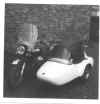 The
photograph at right shows my Moto Guzzi Californian with DJP
sidecar. This shot was taken when the bike was parked outside
St Lukes Methodist Church on the Princes Highway in Morwell.
The
photograph at right shows my Moto Guzzi Californian with DJP
sidecar. This shot was taken when the bike was parked outside
St Lukes Methodist Church on the Princes Highway in Morwell.
Later in the year 1973, or perhaps it was in 1974 - my memory
again! - I went to court where I was awarded damages resulting from
my crash on the night that changed my life. Well my Moto Guzzi
was still awaiting repairs and it became clear that it would probably
never actually get repaired, so Noel Einsiedel offered to buy the
wreck from me. I accepted his offer and had plenty of money to
order a new Moto Guzzi 850 Californian and DJP sidecar. Apart
from the Guzzi and the sidecar, some interesting extras that were
fitted were a pair of white Craven Dolomite fibreglass panniers with
the original Craven luggage rack, and a canvas lap rug. In the
black and white photograph, you can see the chest flap of the lap rug
in place covering the enormous single saddle of the bike.
Behind the seat you can see the black horizontal bars of the enormous
Craven luggage rack. For those who may not remember lap rugs,
they were one of the best inventions for riding motorbikes in the
wet. They covered the whole front of the rider right up to the
neck. the rug was fastened around the bike between the fuel
tank and the front of the seat. The side parts were fastened
to the frame so that the lower portion was wrapped around the toes of
your boots. Side flaps wrapped around your lower and upper legs
and were tucked under your bottom while riding. The top half of
the rug was held against your chest by wind pressure while riding.
Thus, the only parts that could get wet were your arms and your neck
and head. When you were not riding and the bike was parked, the
chest flap covered the saddle to keep it dry.
The Californian was basically the same model as my previous Guzzi
having the same frame, engine and running gear. Important
differences were footboards similar to those used on Indians and
Harleys, an enormous single saddle which was copied from the Harley's
so-called "Buddy Seat", and a very large clear perspex
windshield. With the windshield, the lap rug and the removable
hood of the sidecar, the Californian was probably the best bike I
ever had for riding with two people in heavy rain.
I enjoyed riding that bike for several years.
Our Honeymoon 8th to 14th
February 1976.
Now until the 8th February 1976, I had been a single man.
But that status changed when Wendy Eades came into my life, we
quickly got to know each other really well, I decided I couldn't
think of anyone else that I had ever met that I would rather be
married to (I am still of the same oppinion now in 2005), and to cut
a long story short, Wendy Eades became Wendy Smith on that Sunday
afternoon in February 1976. In planning for our honeymoon, we
decided to go for a holiday using the sidecar outfit. Some
friends from a different church offered us free use of a farmhouse at
Briagolong for a week. A few days before the wedding, we hid
the outfit in the garage of an elderly widow from yet another church,
so none of our friends or enemies knew where it was to be able to
"get at it" during the wedding. The wedding was quite
an occasion with around 350 or 400 people at the reception. It
was a very hot day. After the reception in the evening,
somebody drove us around to where we had hidden the bike and we set
off for Briagolong in the cool of the evening. For most of the
week we hardly started the bike, after all the focus on a honeymoon
is not supposed to be on the bike! However one day we left at
first light and drove up through Dargo into the Alps via Mt
Saint Bernard, Hotham, Mother Johnsons, Omeo, Swifts Creek and
Bairnsdale, eventually getting back to the farmhouse well after
dark. Our week away passed all too quickly, and then it was
back to Morwell and then on to Melbourne where we began married life
in the suburb of Kew.
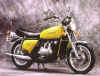 1976:
Honda GL1000 Gold Wing 999cc water-cooled Flat four with DJP sidecar
1976:
Honda GL1000 Gold Wing 999cc water-cooled Flat four with DJP sidecar
The picture at right is not my bike but is identical in colour and
details. In 1975, Honda produced their first flat-four shaft
drive Gold Wing motorcycle. It looked and sounded beautiful and
I wanted one. But my Guzzi Californian was only a couple of
years old and I had looked on that as a bike I might use "for
the rest of my life". So for a year or so I kept using the
Guzzi. But it was amazing how soon little minor annoyances
about imperfect details on the Guzzi began to magnify themselves in
my mind so that I began to lie to myself: "You can't really fix
such-and-such a problem on the Guzzi, you will just have to buy a
Gold Wing to replace it." Its amazing how twisted your
mind can become when you are lusting after the latest motorbike.
Now as a Christian, I knew that lust was wrong. ... But then a Gold
Wing isn't another woman. In retrospect, from thirty years
later, with the perfect 20-20 vision that only wisdom and hindsight
can bring, I can see how the Guzzi would indeed have served me a
great many years and I could have saved a lot of money by not buying
the Gold Wing. However there was some annoying little problem
on the Guzzi which I exaggerated to convince Wendy that we needed to
purchase a new bike. So we did. And the Gold Wing caried
us around for years. I cannot remember why we eventually sold
it, but I remember that I was employed as the Dean of Vision College
in Sydney at the time, so it must have been 1981 or 1982.
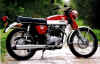 January
and February 1977: Texas to California on the Honda CB350: "Hilda
the Honda"
January
and February 1977: Texas to California on the Honda CB350: "Hilda
the Honda"
After we were married and I was studying for my degree in
Theology, we were hearing a lot about two churches in America where
God appeared to be doing some very interesting and exciting things.
Wendy and I were eligible as full-time students, to get very cheap
tickets for flying to America, so we got passports and tickets and
arrived at Melodyland Christian Centre at 10 Freedman Way, Anaheim in
California on 3rd January 1977. We had nearly two months of
Summer holidays (Summer in Australia, NOT Summer in America - see
below) to look at this church and the Church of the Redeemer, an
Episcopal church at 4411 Dallas Street, South Houston in Texas.
In California we briefly got to know Dean and Linda Davis who hosted
us for a few days while we looked at the church and the Melodyland
School of Theology. We then used a Greyhound bus to get to
Houston and found our way to the church where we were soon put up in
one of their "community houses". We had planned to
purchase a cheap secondhand motorbike for transport to enable us to
see that corner of the US and decided after reading the "Two
Wheels" Road Test that the cheapest and most reliable would
be a Honda CB350. We went to a motorbike shop and bought a nice
secondhand model with sufficient surface rust to lower the price tag
without being dangerous. Wendy christened her "Hilda the
Honda".
 I
have just found this old photo of the Church of the Redeemer with me
sitting on "Hilda the Honda" out in front. The patch
I am wearing on my back is that of "Christ's Crusaders Motor
Cycle Club" which was based in Morwell, Victoria,
Australia.
I
have just found this old photo of the Church of the Redeemer with me
sitting on "Hilda the Honda" out in front. The patch
I am wearing on my back is that of "Christ's Crusaders Motor
Cycle Club" which was based in Morwell, Victoria,
Australia.
"The Coldest Day in 350 years of
Recorded History" The weather
in Houston had been misty and murky and generally unpleasant and the
house we were hosted in was heated to an almost oppressively hot
temperature by the central heating, but then the "Texas Blue
Norther" arrived with brilliant sunshine and crystal clear sunny
blue skies. "Let's ride down to Galveston!" In
just our shirtsleeves we put our Belstaff Jackets in the panniers in
case we needed them, and headed off towards Interstate 45.
Before reaching the Interstate however, we stopped to put on the
Belstaffs. "That's funny ... the sun is streaming down but
the place doesn't feel really warm yet." We soon ascended
the on ramp and were motoring South on the Interstate with the
somewhat irritating ker-thump, ker-thump, ker-thump sound of the
endless repetition of badly-aligned concrete expansion joints.
After a few miles we passed a tower which had a clock and thermometer
which spelled out their readings in lights ... it told us the reading
was 32 degrees. Didn't feel like 32 degrees to us, but then we
remembered that the US is the one place in the world that still uses
the old Fahrenheit temperature scale. 32ºF equals 0ºC
... that's freezing point! But the sky was blue and that sun
was just streaming down at us. We shivered along and I noticed
the strange look on some puddles by the roadside ... they were
covered in ice! As we entered Galveston, another roadside
clock/thermometer cheerily announced that the temperature was 30ºF
(That's -2ºC to the rest of us). Wendy and I were
absolutely frozen so we pulled into McDonalds, more because it would
be warm than because we were hungry. There we were approached
by the local Highway Patrol police who asked us, "What are you
guys doing riding that motor sickle around on a day like this? ... We
are paid to ride, and grumbling every minute we have to do so in this
weather. ... Don't you know this is the coldest day ever recorded in
Galveston in 350 years of recorded history?" Well we
didn't know that so we had to take his word for it. During an
Internet search while typing this web page in 2005, I discovered that
he was not correct. On 12th February 1899 the temperature at
Galveston had fallen to 10º by 08:00. It continued to
fall, bottoming out at 7½º by 11:00. By 13:00 it
had risen to 10º. Details here.
Amazingly, the television news that same evening repeated what the
police had told us: this was the coldest day ever recorded in the
history of Galveston. Seems nobody was looking up their
records. But then in 1977 the Internet was not yet on
everybody's desktops ... in fact hardly anyone had ever seen a
computer.
Anyway, to get back to that ride. We bought the
local newspaper, not to read it, but to stuff it down the front of
our Belstaffs to try to keep the cold out. We went and briefly
stood on the beach out on one of the barrier islands, took a couple
of quick photos, and then hurried back up the Interstate to Houston
and that nice, warm, centrally heated house.
North to
Dallas - Fort Worth After our two
weeks or so with the people from the Church of the Redeemer, we
headed North on Interstate 45 to Dallas.
 The
photo at the right of Wendy beside "Hilda the Honda" was
taken at a rest stop on I-45; it was pouring with rain and Wendy is
wearing her bright pink plastic waterproof gear on top of her
Belstaffs. In Dallas we found our way to the home of Pastor Jim
Hester of the Arlington Christian Church. I had met Jim a
couple of years earlier when he had been visiting Australia.
We went to his church that weekend. On the Monday we travelled
along Interstate 20 to Abilene.
The
photo at the right of Wendy beside "Hilda the Honda" was
taken at a rest stop on I-45; it was pouring with rain and Wendy is
wearing her bright pink plastic waterproof gear on top of her
Belstaffs. In Dallas we found our way to the home of Pastor Jim
Hester of the Arlington Christian Church. I had met Jim a
couple of years earlier when he had been visiting Australia.
We went to his church that weekend. On the Monday we travelled
along Interstate 20 to Abilene.
Our First Wedding
Anniversary: What a Blowout! The next day,
the 8th February 1977, was our first Wedding Anniversary ... how
would we celebrate it? We soon found out. Somewhere between Big
Spring and Odessa, in the bare countryside, miles from anywhere, the
back tyre of the motorbike suddenly blew out. We did not fall
off, but I skillfully and carefully slowed down gradually until we
wobbled to a stop at the side of the road. Now what to do?
We had been strictly warned by many people to never leave our
motorcycle unattended anywhere, or it and everything on it would be
stolen. Should I leave Wendy to guard it while I hitchhiked to
town with the back wheel? No way! This was our very first
Wedding Anniversary! So we parked the bike right there beside
the Interstate, took out the back wheel, left our bright orange
backpacks and our helmets sitting right there on the bike, and
prayed: "Lord, you made blind eyes to see ... now make the
seeing eyes blind for anyone that might want to steal our motorbike
or luggage." Then we hitchhiked a ride in an old ute
(pickup truck) back to Big Spring where we bought a new tyre and had
it fitted. We then hitchhiked back out to our motorbike and
found that God had protected it and nothing had been touched.
We soon had it reassembled and continued on to a small town near
Odessa where we found the local Pizza Hut and celebrated our Wedding
Anniversary with a "Thick and Chewy Pizza Hut Supreme".
That mightn't sound too exciting to everybody else, but it made our
first anniversary one which we shall always remember. As I type
this paragraph on the evening of 7th February 2005, I am looking
forward to celebrating our twenty-ninth Wedding Anniversary
tomorrow!
El Paso, New Mexico, Arizona, California
During the next few days we rode along Interstate 10 to El
Paso. Near El Paso we looked across the river towards Cuidad
Juarez in Chihuahua, Mexico and marvelled at what a difference
crossing a river could make. On the El Paso side everything
appeared to exude richness and prosperity; across the river we saw
only poverty everywhere we looked. We continued into New Mexico
through Las Cruces, Deming and Lordsburg stopping to take many photos
of the beautiful, if somewhat barren countryside. We visited
some National Parks on the way to Tucson and then some more on the
way to Phoenix. It was good to be off the Interstate and
enjoying some back roads. From Phoenix we again headed West
stopping at Blythe after crossing the Colorado River into
California.
The Wrong Side of the Road!
Many miles West of Blythe we were running low on petrol so
we turned off the Interstate to visit a small village named "Desert
Centre" (actually it was spelt "Desert Center" but
that looks so wrong to me when I type it today!) where we filled up
the tank with petrol. Now while riding on the Interstates and
even on the back roads where there was some other traffic, it had not
been a problem to us to have been riding on the "wrong"
side of the road ... in Australia we ride on the left, in America we
ride on the right. But on pulling out of the service station at
Desert Centre, I drove on the left side of the road all the way to
the town's one and only crossroad. There I stopped at the stop
sign just to the left of the centreline, and then made a right hand
turn into the left side of the road that took us back towards the
Interstate. I must have travelled a couple of hundred metres
before I suddenly realised, "Hey! ... This is America! ... I
should be riding on THAT side of the road!" I lost no time
in getting the bike over to the correct side of the road. It is
interesting that, as soon as I found myself in a situation where
there was not one other vehicle in sight, I almost automatically
reverted to driving on the left. It is amazing to me how well
we become programmed to driving on "automatic pilot".
The rest of the trip via Indio and San Bernardino was relatively
uneventful and we soon found our way to Gloria Street and arrived
back at the home of Dean and Linda Davis.
After spending our
final weekend in America visiting the Melodyland Christian Centre
once again we turned Hilda the Honda North and rode to San
Francisco. There we sold the Honda to a secondhand motorbike
dealer and caught our plane back to Australia the same day.
Back in Australia it was back to full-time study and a certain
limited amount of travelling around on the Gold-Wing. But
having seen Melodyland School of Theology, I wanted to attend it for
a year. So I got permission to take a one year break for the
whole of 1978 while I went there to study.
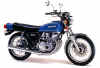 1977-1979
around the 48 contiguous States on a Suzuki 550cc transverse four.
1977-1979
around the 48 contiguous States on a Suzuki 550cc transverse four.
I arrived in Southern California on Christmas Day 1977. The
first thing I did was went to the local motorbike shop and bought a
second-hand GS550 Suzuki that was only about a year old. It was
in truly excellent condition and I had a luggage rack and what the
Americans call a "Travel Trunk" fitted to the back.
It served me well for the year that I owned it. It had four
cylinders in-line across the frame, six-speed gearbox and a chain
final drive. I lived in "Foxy Glen" apartment complex
on Haster Boulevard, Anaheim and studied at Melodyland School of
Theology. I also worked part time, about four hours per day, in
a part of the church known as the Endowment Department. I
didn't need to ride to work as it was only a ten or fifteen minute
walk, but I usually rode anyway, since I always enjoy being on a
motorbike.
My wife came over to join me in May 1978 and we moved
to a different apartment complex in Garden Grove. From there it
was necessary to ride to and from work. I was tested for my
California Driver's Licence for both motorbikes and cars.
Classes ended in the middle of June and didn't start again until
sometime in August, so Wendy and I decided we would go and see the
country. In preparation, I wrote down the addresses of many
students from all parts of the country, saying we couldn't promise,
but we would try to visit many of them during our trip. We
borrowed sleeping bags and a tent and headed North on Highway 101
which followed the coast.
California: Los
Angeles was in those days a smog-ridden place where you often could
not see more than a couple of hundred metres and the pollution in the
smog made your eyes sting, so we lost no time hanging around the
Metropolitan Area. At Santa Barbara, we visited the parents of
Linda Davis with whom we had become good friends.
Miracle at San Francisco.
The Redwoods
Phillipsville
Oregon:
Washington:
The Boeing factory
Spokane
Idaho:
Ya got any spuds?
Montana:
Earthquake
Wyoming:
Yellowstone National Park
North Dakota:
South Dakota:
The big storm
Minnesota:
Only 10,000 lakes?
Wisconsin:
Staying at the farm near Amherst
Iowa:
Illinois:
Meeting Laura in Carbondale
Missouri:
Tennessee:
Kentucky:
Blue grass looks pretty green doesn't it?
Indiana:
Whitestown!
Michigan:
Ohio:
West Virginia:
Pennsylvania:
New York:
Niagara Falls
Rear tyre burst
near Albany
Vermont:
New Hampshire:
Maine:
Connecticut:
The Commonwealth of Massachusetts:
Rhode Island:
Long Island (New York):
Collapse of the
carrier rack: emergency repairs
New York City:
New Jersey:
Miles away from our planned
route on a turnpike with no exits
Pennsylvania:
Horse-drawn carts don't use
petrol!
Camping at midnight and a surprise awakening!
Delaware:
Maryland:
Washington DC:
Virginia:
The hospitable South
North Carolina:
South Carolina:
A new definition for "moss"!
Georgia:
Billy Carter - no trains in Plains
Avoiding
the pile-up in the storm
Florida:
The heat that could kill
Alabama:
Grits
Mississippi:
Louisiana:
Lunch below Sea Level ... the
levees.
Arkansas:
Texas:
The Minah Bird
Oklahoma:
"Go North from Shattuck on
Highway 283"
The Thunderstorm and the floods.
Kansas:
"Wasn't there some cowboy on
telly from Dodge City?"
Nebraska:
Colorado:
The switchback
Silverton to Durango.
The Steam Railway near Durango
New Mexico:
Standing on one foot, but in
four states.
Indian trinkets
Arizona:
"What if we roll out of the tent and into the Grand Canyon?"
Utah:
Zion National Park
Nevada:
Waiting for the night to come.
What
did they think at the motel?
California:
Across Death Valley
Arriving
at Church
1979: the crash at Euroa. In hospital at Shepparton.
1980:Back on the Gold Wing / DJP sidecar outfit.
1981 To Sydney
1982 Around Australia
1982 To England
West Sussex
London
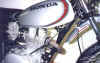
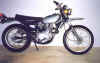
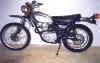 1983:
The old 1972 Honda XL250 Trail Bike
1983:
The old 1972 Honda XL250 Trail Bike
[photos from web until my own photos are located]
Upon my
return from England I had no job and no transport. My friend
from many years earlier, Iain Treacy, rang me one day and asked
if I would like to borrow his Honda XL250 and use it to become a
motorcycle courier carrying parcels and packages around Sydney.
I jumped at the chance and borrowed it from him and sadly, he never
got it back as it was eventually wrecked in a collision. It already
had a very robust back luggage rack fitted and I soon added a pair of
good waterproof panniers to it.
Crisis Couriers "Car
2": I fronted up at Crisis Couriers at 295
Pacific Highway in North Sydney where I met with the boss, Tony
Zanelli, and was introduced to the ins and outs of courier work.
I was issued with a hand-held two-way radio, as the Honda, having
only a 6-volt electrical system, could not support a regular car-type
two-way radio. I was issued with the call sign "Car
Two".
The Honda XL250 had a single sylinder OHC engine, a
very light frame, a high exhaust sytem along the left hand side, and
was fitted at first with knobby tyres. It was designed as a
trail bike and excelled at that task. It could monowheel very
well, something that was more suited to riding the mountain trails
than to commuting around Sydney. In fact, I had not been
riding it very long, when it suddenly tossed me off as
unceremoniously as an unbroken colt would have done. It
happened like this: I had stopped in King Street to make a delivery;
there was a lot of traffic coming up the one-way street and I was
watching for a gap. I spied a short gap, revved up the little
engine and dropped the clutch. I think that the poor little
bike hardly moved. It just wound itself up over the back wheel
and I suddenly found myself upside down on the footpath with the bike
upside down on top of me! Just as well I had a good helmet and
always wore appropriate protective clothing. The bike was
undamaged and nothing was hurt on me other than my pride - I really
felt quite a nong for pulling that stunt - and I soon sorted things
out and was back on my way.
Being a Christian Courier: bags of
cash: secrets: being trusted.
Models in their undies.
Computers
out to Hornsby.
A couple of country runs.
A taxi-truck
load.
The crash at Brookvale: One evening I was
on my way home towards Collaroy Beach and was just sweeping around
the right hand curve on Pittwater Road neat the Brookvale Oval when I
observed a car with a lady driver coming out of Alfred Road stop at
the intersection, apparently to give way to me, which she was
required by law to do according to the layout of the roads. It
was nearly dark, but I already had the lights on and was travelling
at about 50 km/h. Suddenly, when I was almost level with the
car, it jumped forward right in front of me. I hit the horn
button and immediately swerved to the right, but failed to avoid
impacting with the car. The impact of the front bumper of the
car on my left foot crushed the engine case and pressed my foot into
the left side of the crankcase. In an instant my bike was
sliding along the road flat on its side and so was I. I came to
a halt with a left foot that felt very sore indeed. I heard the
traffic start again as the lights changed back at the Winbourne Road
intersection so I quickly leapt to my feet, lifted my bike onto the
median strip in the middle of the road, and then immediately fell
down again. There was a big enough pool of engine oil that had
leaked from the Honda's crankcase to mark where it had slid to a
stop. The ambulance men decided that since no bomes had been
broken and that I was quite conscious, there was no need to take me
to hospital, so they went away and left me sitting there on the
nature strip. Eventually the police drove me home in the police
car, but I was off my feet for a day or two.
The bad news from
the motorcycle shop, Rama Motorcycles, where my bike had been taken
was that the bike was unrepairable: because of its age it was
impossible to get parts for it without specially importing them: it
would be off the road for a great many months at the best, or might
possible never be repaired. I arranged to have it brought to my
home, and since my livelihood was now gone took immediate steps to
purchase a new motorbike. This time I bought a Kawasaki LTD
250.
However, this was not quite the end of the road for the XL
Honda. I was able to buy a second-hand non-running engine and
other parts and after many long cold nights down in that breezy shed,
I was able to rebuild the engine of the Honda and eventually had it
running again. As it was still registered I rode it when the
Kawasaki was in for repairs. I also loaned it to other courier
riders who for some reason or another were without their bikes for a
few days.
 1984:
Kawasaki LTD 250
1984:
Kawasaki LTD 250
[photos from web until my own photos are located]
1986 New Zealand
 1987-1989:
The 1986? Honda Spacey 250cc scooter.
1987-1989:
The 1986? Honda Spacey 250cc scooter.
[photos from web until my own photos are located]
Having returned to Australia from New Zealand, transport was
needed and one day an advertisement for a secondhand 250cc Honda
Scooter caught my eye. I am not sure now of the year of
manufacture of my Honda Spacey scooter, but it was probably about
1986. Its previous owner had bought it brand new and had to
sell it in a hurry as his student days had ended and he was returning
to Hong Kong. This meant that I bought a hardly-used, as-new
scooter for a very cheap price. Having ridden everything from
Honda monkey-bikes to Harleys, how did I find the Spacey? Well,
it has to have been about the easiest bike I ever owned to ride
around town. It was a 250cc water-cooled single driving through
"V-Matic" V-belt automatic transmission. No clutch.
No gear changing. Just start it up with a press on the starter
button and drive it away. It was powerful enough that you
almost imagined you could lift the front wheel if you opened her up
too quickly, although I cannot remember having actuall;y done so.
It accelerated magnificently through Sydney's dense traffic and was
great for making the extra lane through to the front of the pack at
every set of lights. Having reached the front, when those
lights changed, I had no fear of being run over from behind; that
little Spacey could take off a lot faster than any four wheeler and a
lot faster than most two wheelers. With the infinitely-variable
gearing meaning that there were no gear changes at all, it just kept
accelerating faster and faster.
Out on the freeway, people would
do a kind of double-take when they glanced sideways to see a scooter
speeding past when they were already exceeding 100 km/h. I
cannot recall what its highest speed was, but I seem to recall seeing
120 km/h or more on the excellent digital speedometer. In fact
if I recall correctly, the speedometer was not actually called a
speedometer in the manual, but a "Digital Average Speed Computer
And Display unit" and had an abreviation of "DASCAD".
I would be very interested to hear from any owner who still has a
manual whether I have recalled that correctly. It put up a new
speed display about once each second, so the speeds displayed were
actually very widely spaced figures when you were accelerating
rapidly.
At freeway speeds, the ultra-short wheelbase of the
machine made for less than desirable handling. Looking back
with my minds eye, I would estimate the wheelbase to have been in the
order of only 1167 to 1170 mm or thereabouts; once again, I would
love to get hold of a manual and find out for sure. Thus the
slipstream of other vehicles or gustiness of the wind would interfere
with the smoothness of your ride. Also, the smaller diameter
wheels along with the short wheelbase made it less than precise when
cornering compared to a regular motorbike. However, I soon got
used to it and thoroughly enjoyed commuting around Sydney on it.
I especially liked driving it in the wet when the footboards and
front fairing together with the ample windscreen would keep me nice
and dry. Brakes werepretty good, although I scared myself the
first wet day by locking the front wheel with the disc brake.
The bike was light on the front end and with leading link forks also
not causing any of the expected "nosedive", it was just too
easy to give the front brake too much of a squeeze. The rear
drum brake also was very good and much harder to lock up as there was
much more weight on the rear end.
I recall that the V-matic
transmission had a habit that was very disconcerting when you were
rolling to a stop. Slowing down from high speeds, the machine
had a very good engine-braking effect until it had slowed to about 10
or 15 km/h, when suddenly, it was as if all braking had been released
and the scooter would start just free rolling, like any normal bike
suddenly being shifted into neutral. It only worried me the
first couple of times however, and I soon became used to applying the
rear brake just before the engine-braking suddenly gave up.
The
seat on this scooter was superb: nice and wide and soft enough that
it felt like you could stay in the saddle all day. It was a
little more crowded however, when my wife Wendy would join me as
pillion passenger. Good lockable helmet locks were provided so
that the helmets could be locked while the bike was parked.
This machine also had a generous rear luggage rack. The glove
compartment in the front of the rider could also hold a lot of
stuff.
Altogether, the Honda Spacey was one delightful bike to
own and ride. And yes, if the situation called for it, I would
not hesitate to purchase another one.
Note that I have also seen
these bikes in other countries labeled as Elite, Freeway, and Helix,
so perhaps Spacey might have been only the Australian name for this
model.
Just as its previous owner had to sell the bike in a
hurry because he was moving to Hong Kong, so the same thing happened
to me. I moved to Hong Kong on 29th March 1989 and had to sell
the wonderful Spacey in a hurry to some lucky buyer.
1989: To Hong Kong ... and no motorbikes for more
than 15 years
In August 1989, Wendy and I visited Guangzhou in Guangdong
Province, China, and while we were there we saw three PLA troops on a
CJ750 sidecar outfit. I decided that day that I wanted to own
one of these things one day.
The info about my CJ has now been moved to this
new page.
Alphabetical list of bikes I
have actually ridden, even if only once around the block!
A: Adler, Aermacchi, AJS, Ariel, AJW, Anzani,
Argus, Aprilia, Albion,
B: BMW, BSA,
Brough-Superior, Benelli, Bultaco, Bridgestone
C:
Calthorpe, Chang Jiang, CZ, Cotton, Coventry Eagle,
D:
DKW, Dnepr, 1898 DeDion Bouton motor tricycle with original
wickerwork passenger trailer, DJP sidecars, Dusting sidecars, Ducati,
DOT,
E: Excelsior, ESO, EMW
F:
Francis Barnett, Fuji,
G: Gilera,
Guzzi, Greeves,
H: Horex, HRD Vincent,
Harley-Davidson (many models), Honda, Henderson, Hobby (German,
possibly by DKW), Husquvarna
I: Indian,
J:
Jawa, James, JAP,
K: Kawasaki,
L:
Lilac, Laverda, Lambretta, Levis
M: M-series
M500 (now called "Ural"), MV, Moto Guzzi, Matchless,
Morini, MZ, Motobi, Montesa, Maico, Maicoletta, Marusho
N:
Norton, NSU, Nimbus, NUT,
O: Oscar, Omega,
P:
Piaggio, Prestwick, Panther, Puch,
Q: Quadrant,
QUB, Quickly,
R: Rex, Rabbit, Rikuo, Rudge,
Royal Enfield,
S: Suzuki, Solex, Scott,
Stevens, Sunbeam
T: Triumph, Tilbrook,
Triton,
U: Ursa, Ural,
V:
Velocette, Vespa, Vincent, VeloSolex, Volkswagen 2WD sidecar
outfit, Vulcan, Villiers,
W: Watsonian
sidecars,
X: X (made by Henderson),
Y:
Yamaha,
Z: Zundapp, Zaluki,
2006-12-29

NOTE:
If you know of any links which
you think should be added to this page, or if you find that some of
the links on this page do not work, or if links now lead to
unsuitable content, please email me at phil
DOT drdisk AT gmail DOT com to advise me
of the details.
This page
was last updated on
21/05/10 at
19:25:21
Hong Kong Time.
You
are visitor number
 (total hits to all pages in this web-site) since 24th June 1997.
Copyright
© 1996 - 2010 Phil Smith, all rights reserved. All contents in
this web site are provided as is without warranty of any kind. Phil
Smith expressly disclaims any liability from the use of any
information in this web site.
Note:
for sections of some of the pages within this site attributed to
[HKO]:
the
links and materials provided therein are supplied by the Hong
Kong Observatory and
the following Notice is applicable to those sections: Copyright
Notice: All weather information shown here, including but not
limited to all text, graphics, drawings, diagrams, photographs and
compilation of data or other materials are provided by the Hong Kong
Observatory. Any reproduction, adaptation, distribution,
dissemination or making available of such copyright works to the
public is strictly prohibited unless prior written authorization is
obtained from the Hong Kong Observatory.
Note that the e-mail address for Phil Smith (also known as
"Doctor Disk") has been changed to phil
DOT drdisk AT gmail DOT com with
effect from 18th March 2006. To use this e-mail address, in
your e-mail program's "To" field, type out the words in
blue replacing "
AT " with
"@"
and replacing "
DOT
" with "."
so that there are no spaces. Sorry for the inconvenience, but
my junk mail had passed 1,000 items per day.
You
have reached the bottom of this page. To help with navigation
we include links to many of our pages in this Search Bar:
Making Money on the Web; Travels
by Motorbikes and Sidecars About
Phil Smith, (includes Wendy, Victor, Nina, Benjamin, Rosemary), ;
About Doctor Disk, ; ACA,
ACoA, Adult children, ; Hurricane
Frances ; Hurricane Aldonca;
Adopt, Adoption, AFHK, Adoptive
Families of Hong Kong, ; Archives of
typhoons, (Sam, Wendy, York, etc.), storm and weather information,
; Computers, computer, PC, pc, (misspelt:
computor, computre, computr, compter, cmputer, cmputr), ;
Currency Converter, Foreign Exchange
Converter, Currency Calculator, Foreign Exchange Calculator ;
Contact Details for Doctor Disk and Phil
Smith, ; Cyclone, typhoon, storm
information, ; Data Recovery,
DriveSavers, ; Home,
Home page, Default page, ; Essential
safeguards for computing, ; Faith,
Statement of Faith, Jesus Christ, Jesus, Christ, Christian, ;
Family photographs, ; Family
Computers, computer prices, printer, printers, scanner, scanners,
price list, ; Handy Hong Kong Links, ;
HK typhoon / cyclone tracking map, ;
Hurricane Aldonca; How
to insert a British (Sterling) Pound sign, ; Services,
Charges, Fees, Troubleshooting, trouble shooting, trouble-shooting,
house calls in Hongkong, Forensic, Forensics, consultants,
consultancy, ; Tracking maps for typhoon
/ cyclone / storm for HK and Australia, ; Typhoons,
archive and Weather pages, ; Upgrades
price list, ; Warranty info for PC /
computer, ; Motorbikes
and Sidecars,
Chang Jiang 750, CJ750,
Diary of an Enthusiast, ; Weather
information pages. Other sites:
http://www.1MillionDollarsInGoogleAdsFree.com/drdisk
; OzCruisers.com, Australian
Motorcycle Tours. Web
Riders For Christ Disciples
CMC Sidecar
enthusiasts: Please contribute to the new Sidecar
Wiki End of
Search Bar.
-